Ch.7 - Quantum-Mechanical Model of the Atom
Tro - Chemistry: A Molecular Approach 4th Edition
Tro4th EditionChemistry: A Molecular ApproachISBN: 9780134112831Non è quello che usi tu?Cambia libro di testo
Capitolo 7, Problema 45

Determine the energy of 1 mol of photons for each kind of light. (Assume three significant figures.) a. infrared radiation (1500 nm) b. visible light (500 nm) c. ultraviolet radiation (150 nm)

Guida verificata passo dopo passo
1
Step 1: Recall the energy of a photon can be calculated using the equation: E = h * c / λ, where E is the energy, h is Planck's constant (6.626 x 10^-34 J*s), c is the speed of light (3.00 x 10^8 m/s), and λ is the wavelength.
Step 2: Convert the wavelength from nanometers to meters. 1 nm = 1 x 10^-9 m. So, 1500 nm = 1500 x 10^-9 m = 1.5 x 10^-6 m.
Step 3: Substitute the values into the equation to calculate the energy of one photon: E = (6.626 x 10^-34 J*s) * (3.00 x 10^8 m/s) / (1.5 x 10^-6 m).
Step 4: To find the energy of 1 mol of photons, multiply the energy of one photon by Avogadro's number (6.022 x 10^23). So, E(mol) = E * (6.022 x 10^23).
Step 5: The result from step 4 is the energy of 1 mol of infrared radiation photons.

Risposta video verificata per un problema simile:

Questa soluzione video è stata consigliata dai nostri tutor come utile per risolvere questo problema.
Durata del video:
4m

Concetti chiave

Ecco i concetti essenziali che devi comprendere per rispondere correttamente alla domanda.

Photon Energy

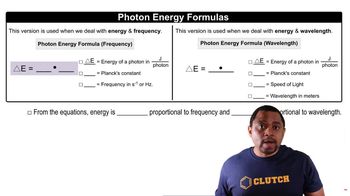
Photon energy is the energy carried by a single photon, which can be calculated using the equation E = hc/λ, where E is energy, h is Planck's constant, c is the speed of light, and λ is the wavelength of the light. This relationship shows that energy is inversely proportional to wavelength; shorter wavelengths correspond to higher energy photons.
Video consigliato:
Percorso guidato
01:40
Photon Energy Formulas

Wavelength and Frequency

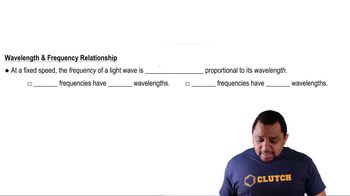
Wavelength and frequency are fundamental properties of electromagnetic radiation. Wavelength (λ) is the distance between successive peaks of a wave, while frequency (ν) is the number of wave cycles that pass a point per second. They are related by the equation c = λν, where c is the speed of light, indicating that as wavelength increases, frequency decreases.
Video consigliato:
Percorso guidato
00:31
Frequency-Wavelength Relationship

Moles and Avogadro's Number

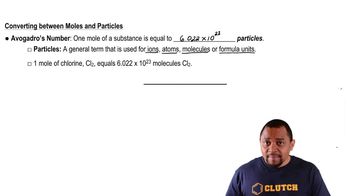
A mole is a unit in chemistry that represents 6.022 x 10²³ entities, such as atoms or photons. When calculating the energy of 1 mol of photons, it is essential to multiply the energy of a single photon by Avogadro's number to find the total energy for that amount of photons, allowing for practical calculations in chemical contexts.
Video consigliato:
Percorso guidato
02:41
Moles and Particles Conversion