Ch.7 - Quantum-Mechanical Model of the Atom
Tro - Chemistry: A Molecular Approach 4th Edition
Tro4th EditionChemistry: A Molecular ApproachISBN: 9780134112831Non è quello che usi tu?Cambia libro di testo
Capitolo 7, Problema 50

The smallest atoms can themselves exhibit quantum-mechanical behavior. Calculate the de Broglie wavelength (in pm) of a hydrogen atom traveling at 475 m/s.

Guida verificata passo dopo passo
1
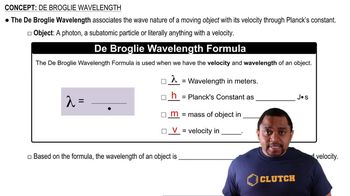
Identify the formula for the de Broglie wavelength: \( \lambda = \frac{h}{mv} \), where \( \lambda \) is the wavelength, \( h \) is Planck's constant (\( 6.626 \times 10^{-34} \) Js), \( m \) is the mass of the particle, and \( v \) is the velocity.
Determine the mass of a hydrogen atom. The mass of a hydrogen atom is approximately \( 1.67 \times 10^{-27} \) kg.
Substitute the given velocity of the hydrogen atom, \( v = 475 \) m/s, into the de Broglie wavelength formula.
Substitute the values for Planck's constant, the mass of the hydrogen atom, and the velocity into the formula: \( \lambda = \frac{6.626 \times 10^{-34}}{1.67 \times 10^{-27} \times 475} \).
Calculate the de Broglie wavelength in meters and then convert it to picometers (1 pm = \( 10^{-12} \) m) for the final answer.

Risposta video verificata per un problema simile:

Questa soluzione video è stata consigliata dai nostri tutor come utile per risolvere questo problema.
Durata del video:
6m

Concetti chiave

Ecco i concetti essenziali che devi comprendere per rispondere correttamente alla domanda.

de Broglie Wavelength

The de Broglie wavelength is a fundamental concept in quantum mechanics that describes the wave-like behavior of particles. It is given by the formula λ = h/p, where λ is the wavelength, h is Planck's constant, and p is the momentum of the particle. For a moving particle, momentum is calculated as the product of its mass and velocity. This concept illustrates the dual nature of matter, where particles exhibit both wave and particle characteristics.
Video consigliato:
Percorso guidato
00:58
De Broglie Wavelength Formula

Planck's Constant

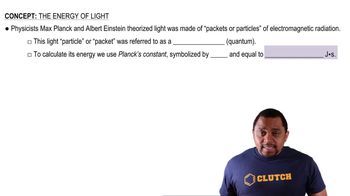
Planck's constant (h) is a fundamental physical constant that relates the energy of a photon to the frequency of its associated electromagnetic wave. Its value is approximately 6.626 x 10^-34 J·s. In the context of the de Broglie wavelength, it serves as a bridge between classical and quantum physics, allowing for the calculation of wavelengths associated with moving particles, such as atoms and electrons.
Video consigliato:
Percorso guidato
00:50
Photons and Planck's Constant

Momentum

Momentum is a vector quantity defined as the product of an object's mass and its velocity (p = mv). In the context of quantum mechanics, momentum plays a crucial role in determining the behavior of particles, including their de Broglie wavelength. For a hydrogen atom, knowing its mass and velocity allows us to calculate its momentum, which is essential for finding its associated wavelength and understanding its quantum behavior.
Video consigliato:
Percorso guidato
00:40
Angular Momentum Quantum Number