Ch.8 - Periodic Properties of the Elements
Tro - Chemistry: A Molecular Approach 4th Edition
Tro4th EditionChemistry: A Molecular ApproachISBN: 9780134112831Non è quello che usi tu?Cambia libro di testo
Capitolo 8, Problema 63

Arrange these elements in order of increasing atomic radius: F, S, Si, Ge, Ca, Rb.

Guida verificata passo dopo passo
1
Identify the periodic trend for atomic radius: Atomic radius increases as you move down a group and decreases as you move across a period from left to right.
Locate each element on the periodic table: F (Fluorine), S (Sulfur), Si (Silicon), Ge (Germanium), Ca (Calcium), Rb (Rubidium).
Compare elements within the same group: Ge and Si are in Group 14, with Ge below Si, so Ge has a larger atomic radius than Si.
Compare elements within the same period: F, S, and Si are in Period 2 and 3, with F having the smallest atomic radius and Si the largest among them.
Arrange the elements based on their position in the periodic table, considering both group and period trends: F, S, Si, Ge, Ca, Rb.

Concetti chiave

Ecco i concetti essenziali che devi comprendere per rispondere correttamente alla domanda.

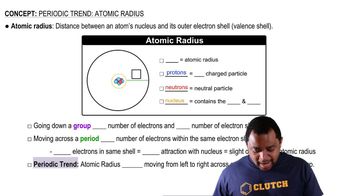
Atomic Radius

Atomic radius is a measure of the size of an atom, typically defined as the distance from the nucleus to the outermost electron shell. It generally increases down a group in the periodic table due to the addition of electron shells, while it decreases across a period from left to right due to increased nuclear charge, which pulls electrons closer to the nucleus.
Video consigliato:

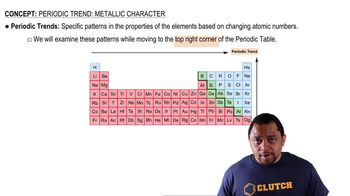
Periodic Trends

Periodic trends refer to predictable patterns in the properties of elements as you move across or down the periodic table. Key trends include atomic radius, ionization energy, and electronegativity. Understanding these trends helps in predicting the behavior of elements, including their size and reactivity.
Video consigliato:
Percorso guidato
00:38
Periodic Trends

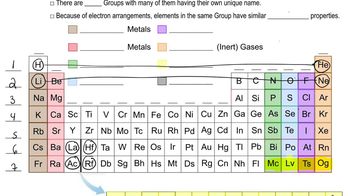
Group and Period

Elements in the periodic table are organized into groups (columns) and periods (rows). Elements in the same group often exhibit similar chemical properties and have the same number of valence electrons, while elements in the same period have the same number of electron shells. This organization is crucial for understanding atomic size and other properties.
Video consigliato:
Percorso guidato
05:33
Periodic Table: Group Names