Ch.8 - Periodic Properties of the Elements
Tro - Chemistry: A Molecular Approach 4th Edition
Tro4th EditionChemistry: A Molecular ApproachISBN: 9780134112831Non è quello che usi tu?Cambia libro di testo
Capitolo 8, Problema 99

Consider these elements: N, Mg, O, F, Al. a. Write the electron configuration for each element. b. Arrange the elements in order of decreasing atomic radius. c. Arrange the elements in order of increasing ionization energy. d. Use the electron configurations in part a to explain the differences between your answers to parts b and c.

Guida verificata passo dopo passo
1
Step 1: Write the electron configuration for each element. For example, for Nitrogen (N), determine the number of electrons and fill the orbitals following the Aufbau principle.
Step 2: Arrange the elements in order of decreasing atomic radius. Consider the periodic trend that atomic radius decreases across a period and increases down a group.
Step 3: Arrange the elements in order of increasing ionization energy. Remember that ionization energy generally increases across a period and decreases down a group.
Step 4: Compare the electron configurations from part a to explain the differences in atomic radius. Consider the number of electron shells and the effective nuclear charge.
Step 5: Use the electron configurations to explain the differences in ionization energy. Consider the stability of the electron configuration and the energy required to remove an electron.

Concetti chiave

Ecco i concetti essenziali che devi comprendere per rispondere correttamente alla domanda.

Electron Configuration

Electron configuration describes the distribution of electrons in an atom's orbitals. It is represented using a notation that indicates the energy levels and sublevels occupied by electrons, following the Aufbau principle, Pauli exclusion principle, and Hund's rule. Understanding electron configurations is crucial for predicting an element's chemical behavior and properties, including its reactivity and placement in the periodic table.
Video consigliato:
Percorso guidato
01:33
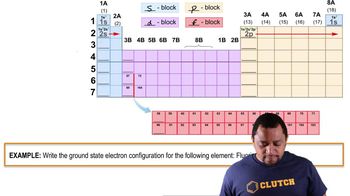
Electron Configuration Example

Atomic Radius

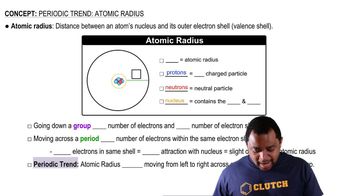
Atomic radius is a measure of the size of an atom, typically defined as the distance from the nucleus to the outermost electron shell. Atomic radius generally increases down a group in the periodic table due to the addition of electron shells, while it decreases across a period from left to right due to increased nuclear charge, which pulls electrons closer to the nucleus. This concept is essential for understanding trends in element size and their implications for chemical bonding.
Video consigliato:

Ionization Energy

Ionization energy is the energy required to remove an electron from an atom in its gaseous state. It generally increases across a period due to higher effective nuclear charge and decreases down a group as the outer electrons are further from the nucleus and experience greater shielding. This concept is vital for understanding an element's reactivity and its ability to form ions, which directly relates to the trends observed in atomic radius.
Video consigliato:
Percorso guidato
01:19
Ionization Energy