Ch.8 - Periodic Properties of the Elements
Tro - Chemistry: A Molecular Approach 4th Edition
Tro4th EditionChemistry: A Molecular ApproachISBN: 9780134112831Non è quello che usi tu?Cambia libro di testo
Capitolo 8, Problema 44a

Write the full orbital diagram for each element. a. S

Guida verificata passo dopo passo
1
1. Identify the atomic number of the element. The atomic number of Sulfur (S) is 16. This means there are 16 electrons in a neutral atom of sulfur.
2. Write the electron configuration for the element. The electron configuration of Sulfur (S) is 1s² 2s² 2p⁶ 3s² 3p⁴.
3. Draw the orbital diagram. Each orbital is represented by a box and each electron by an arrow. The arrows pointing up and down represent the electron spin.
4. Fill in the electrons. The 1s orbital gets 2 electrons, the 2s orbital gets 2 electrons, the 2p orbital gets 6 electrons, the 3s orbital gets 2 electrons, and the 3p orbital gets 4 electrons.
5. Remember the Pauli Exclusion Principle, which states that each orbital can hold a maximum of two electrons with opposite spins. Also, Hund's Rule states that electrons will fill an empty orbital in the same subshell before they pair up.

Risposta video verificata per un problema simile:

Questa soluzione video è stata consigliata dai nostri tutor come utile per risolvere questo problema.
Durata del video:
2m

Concetti chiave

Ecco i concetti essenziali che devi comprendere per rispondere correttamente alla domanda.

Electron Configuration

Electron configuration describes the distribution of electrons in an atom's orbitals. It follows the Aufbau principle, which states that electrons fill orbitals starting from the lowest energy level to the highest. For sulfur (S), with an atomic number of 16, the electron configuration is 1s² 2s² 2p⁶ 3s² 3p⁴, indicating how electrons are arranged in its orbitals.
Video consigliato:
Percorso guidato
01:33
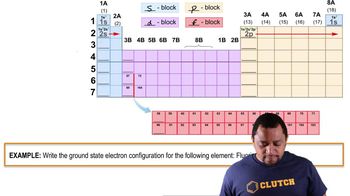
Electron Configuration Example

Orbital Diagrams

Orbital diagrams visually represent the arrangement of electrons in an atom's orbitals. Each orbital can hold a maximum of two electrons with opposite spins, depicted as arrows pointing in opposite directions. For sulfur, the orbital diagram would show the filling of the 1s, 2s, 2p, 3s, and 3p orbitals, illustrating how electrons occupy these spaces.
Video consigliato:
Percorso guidato
01:16
Electron Orbital Diagrams

Hund's Rule

Hund's Rule states that electrons will fill degenerate orbitals (orbitals of the same energy) singly before pairing up. This minimizes electron-electron repulsion and stabilizes the atom. In the case of sulfur, the 3p orbitals will each receive one electron before any pairing occurs, leading to a more stable electron configuration.
Video consigliato:
Percorso guidato
00:28
Solubility Rules