
Ch.9 - Chemical Bonding I: The Lewis Model
Tro - Chemistry: A Molecular Approach 4th Edition
Tro4th EditionChemistry: A Molecular ApproachISBN: 9780134112831Non è quello che usi tu?Cambia libro di testo
Capitolo 9, Problema 90

Amino acids are the building blocks of proteins. The simplest amino acid is glycine (H2NCH2COOH). Draw a Lewis structure for glycine. (Hint: The central atoms in the skeletal structure are nitrogen and the two carbon atoms. Each oxygen atom is bonded directly to the right-most carbon atom.)

Guida verificata passo dopo passo
1
Identify the atoms and their valence electrons: Nitrogen (N) has 5 valence electrons, Carbon (C) has 4, Oxygen (O) has 6, and Hydrogen (H) has 1.
Arrange the atoms according to the skeletal structure: H2N-CH2-COOH, with nitrogen and the two carbon atoms as central atoms.
Connect the atoms with single bonds: Connect N to CH2, CH2 to C, and C to both O atoms. Also, connect the hydrogens to N and CH2, and one hydrogen to one of the O atoms.
Distribute the remaining electrons to satisfy the octet rule: Start by completing the octets of the outer atoms (O and N) and then adjust the central atoms (C) if needed.
Check for formal charges and adjust if necessary: Ensure that the formal charges are minimized, possibly by forming a double bond between the carbon and one of the oxygen atoms.

Risposta video verificata per un problema simile:

Questa soluzione video è stata consigliata dai nostri tutor come utile per risolvere questo problema.
Durata del video:
2m

Concetti chiave

Ecco i concetti essenziali che devi comprendere per rispondere correttamente alla domanda.

Amino Acids

Amino acids are organic compounds that serve as the building blocks of proteins. Each amino acid contains a central carbon atom, an amino group (–NH2), a carboxyl group (–COOH), a hydrogen atom, and a variable side chain (R group) that determines the specific properties of the amino acid. Glycine, the simplest amino acid, has a hydrogen atom as its side chain.
Video consigliato:

Lewis Structures

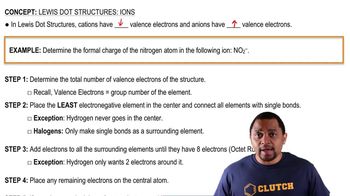
Lewis structures are diagrams that represent the bonding between atoms in a molecule and the lone pairs of electrons that may exist. They are useful for visualizing the arrangement of atoms and the distribution of electrons. In the case of glycine, the Lewis structure will show the connectivity between the nitrogen, carbon, and oxygen atoms, as well as the placement of hydrogen atoms.
Video consigliato:
Percorso guidato
04:28
Lewis Dot Structures: Ions

Skeletal Structure

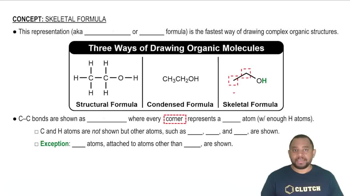
The skeletal structure of a molecule is a simplified representation that focuses on the arrangement of atoms and the bonds between them, often omitting hydrogen atoms for clarity. In glycine, the skeletal structure emphasizes the central nitrogen and carbon atoms, illustrating how they are connected to each other and to the functional groups, which is essential for drawing an accurate Lewis structure.
Video consigliato:
Percorso guidato
02:26
Skeletal Formula