Ch.9 - Chemical Bonding I: The Lewis Model
Tro - Chemistry: A Molecular Approach 4th Edition
Tro4th EditionChemistry: A Molecular ApproachISBN: 9780134112831Non è quello che usi tu?Cambia libro di testo
Capitolo 9, Problema 11

Is this question formulated correctly? If not, please fix it and return the output as a JSON of the form: {'question': 'question text'}. Here is the question: Calculate ΔH° for the reaction H2(g) + Br2(g) → 2 HBr(g) using bond energy values. The ΔH°f of HBr(g) is not equal to one-half of the value calculated. Account for the difference.

Guida verificata passo dopo passo
1
Step 1: Understand the problem. We need to calculate the enthalpy change (ΔH°) for the reaction using bond energies and then compare it to the standard enthalpy of formation (ΔH°f) of HBr(g).
Step 2: Write the balanced chemical equation: H2(g) + Br2(g) → 2 HBr(g).
Step 3: Identify the bonds broken and formed. Breaking bonds requires energy, while forming bonds releases energy. In this reaction, we break one H-H bond and one Br-Br bond, and form two H-Br bonds.
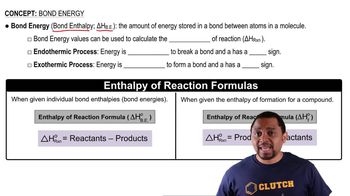
Step 4: Use bond energy values to calculate the total energy change. The formula is: ΔH° = Σ(Bond energies of bonds broken) - Σ(Bond energies of bonds formed).
Step 5: Compare the calculated ΔH° with the given ΔH°f of HBr(g). If they differ, consider factors such as experimental conditions or the precision of bond energy values that might account for the discrepancy.

Concetti chiave

Ecco i concetti essenziali che devi comprendere per rispondere correttamente alla domanda.

Bond Energy

Bond energy is the amount of energy required to break one mole of a bond in a gaseous substance. It is a crucial concept in thermochemistry, as it allows for the calculation of the enthalpy change (ΔH) of a reaction by summing the bond energies of the reactants and products. Understanding bond energies helps explain why the calculated ΔH° may differ from standard formation enthalpies.
Video consigliato:

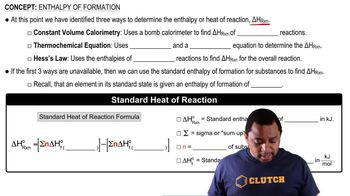
Enthalpy of Formation (ΔH°f)

The enthalpy of formation (ΔH°f) is the change in enthalpy when one mole of a compound is formed from its elements in their standard states. It is a specific type of enthalpy change that provides a reference point for calculating the energy changes in chemical reactions. The discrepancy mentioned in the question arises because ΔH°f values account for the stability of the compound in its standard state, which may not directly correlate with bond energies.
Video consigliato:
Percorso guidato
02:34
Enthalpy of Formation

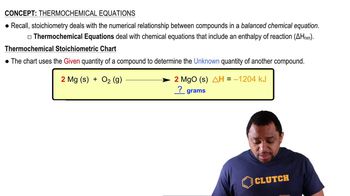
Thermochemical Equations

Thermochemical equations represent the relationship between heat and chemical reactions, indicating the enthalpy change associated with a reaction. These equations are essential for understanding how energy is absorbed or released during a reaction. The question highlights the importance of accurately interpreting these equations to reconcile differences between calculated bond energies and experimentally determined ΔH°f values.
Video consigliato:
Percorso guidato
01:13
Thermochemical Equations