Ch.9 - Chemical Bonding I: The Lewis Model
Tro - Chemistry: A Molecular Approach 4th Edition
Tro4th EditionChemistry: A Molecular ApproachISBN: 9780134112831Non è quello che usi tu?Cambia libro di testo
Capitolo 9, Problema 55a

Determine if a bond between each pair of atoms would be pure covalent, polar covalent, or ionic. a. Br and Br

Guida verificata passo dopo passo
1
Step 1: Identify the type of bond between the atoms by looking at the difference in electronegativity values. Electronegativity is a measure of the tendency of an atom to attract a bonding pair of electrons. The Pauling scale is the most commonly used electronegativity scale.
Step 2: If the difference in electronegativity is less than 0.5, the bond is considered pure covalent. If the difference is between 0.5 and 1.7, the bond is polar covalent. If the difference is greater than 1.7, the bond is ionic.
Step 3: In this case, we are looking at a bond between two identical atoms, Br and Br. The electronegativity difference between identical atoms is always zero.
Step 4: Since the electronegativity difference is less than 0.5, the bond between Br and Br is a pure covalent bond.

Risposta video verificata per un problema simile:

Questa soluzione video è stata consigliata dai nostri tutor come utile per risolvere questo problema.

Concetti chiave

Ecco i concetti essenziali che devi comprendere per rispondere correttamente alla domanda.

Types of Chemical Bonds

Chemical bonds can be classified into three main types: ionic, covalent, and polar covalent. Ionic bonds occur when electrons are transferred from one atom to another, resulting in charged ions. Covalent bonds involve the sharing of electrons between atoms, while polar covalent bonds occur when the sharing is unequal, leading to partial charges.
Video consigliato:

Electronegativity

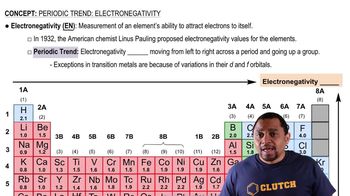
Electronegativity is a measure of an atom's ability to attract and hold onto electrons in a bond. The difference in electronegativity between two atoms determines the type of bond formed: a small difference indicates a covalent bond, a moderate difference indicates a polar covalent bond, and a large difference suggests an ionic bond.
Video consigliato:
Percorso guidato
02:10
Electronegativity Trends

Homodiatomic Molecules

Homodiatomic molecules consist of two identical atoms, such as Br2. In these cases, the electronegativity difference is zero, leading to a pure covalent bond since the electrons are shared equally between the two atoms, resulting in no partial charges.
Video consigliato:
Percorso guidato
02:38
Heteronuclear Diatomic Molecules