
Domanda del libro di testo
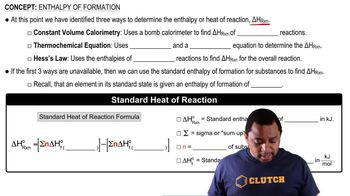
Ethanol is a possible fuel. Use average bond energies to calculate ΔHrxn for the combustion of ethanol. CH3CH2OH(g) + 3 O2(g) → 2 CO2(g) + 3 H2O(g)
2906
views

 Guida verificata passo dopo passo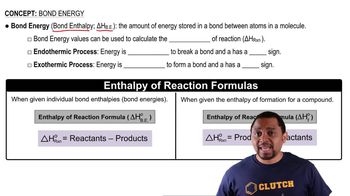
 01:50
01:50
 02:34
02:34 01:16
01:16Ethanol is a possible fuel. Use average bond energies to calculate ΔHrxn for the combustion of ethanol. CH3CH2OH(g) + 3 O2(g) → 2 CO2(g) + 3 H2O(g)
Write an appropriate Lewis structure for each compound. Make certain to distinguish between ionic and molecular compounds. b. ClF5
In the Chemistry and the Environment box on free radicals in this chapter, we discussed the importance of the hydroxyl radical in reacting with and eliminating many atmospheric pollutants. However, the hydroxyl radical does not clean up everything. For example, chlorofluorocarbons—which destroy stratospheric ozone—are not attacked by the hydroxyl radical. Consider the hypothetical reaction by which the hydroxyl radical might react with a chlorofluorocarbon: OH(g) + CF2Cl2(g) → HOF(g) + CFCl2(g) Use bond energies to explain why this reaction is improbable. (The C–F bond energy is 552 kJ/mol.)
Hydrogenation reactions are used to add hydrogen across double bonds in hydrocarbons and other organic compounds. Use average bond energies to calculate ΔHrxn for the hydrogenation reaction. H2C=CH2(g) + H2(g) → H3C–CH3(g)
Which of the two compounds, H2NNH2 and HNNH, has the strongest nitrogen-nitrogen bond, and which has the shorter nitrogen-nitrogen bond.