Ch.9 - Chemical Bonding I: The Lewis Model
Tro - Chemistry: A Molecular Approach 4th Edition
Tro4th EditionChemistry: A Molecular ApproachISBN: 9780134112831Non è quello che usi tu?Cambia libro di testo
Capitolo 9, Problema 103c

Some theories of aging suggest that free radicals cause certain diseases and perhaps aging in general. As you know from the Lewis model, such molecules are not chemically stable and will quickly react with other molecules. According to certain theories, free radicals may attack molecules within the cell, such as DNA, changing them and causing cancer or other diseases. Free radicals may also attack molecules on the surfaces of cells, making them appear foreign to the body's immune system. The immune system then attacks the cells and destroys them, weakening the body. Draw Lewis structures for each free radical implicated in this theory of aging. c. OH

Guida verificata passo dopo passo
1
Identify the total number of valence electrons for the OH radical. Oxygen has 6 valence electrons, and hydrogen has 1 valence electron, giving a total of 7 valence electrons.
Recognize that a free radical is a species with an unpaired electron. In the case of OH, this means that one of the electrons will not be paired in the Lewis structure.
Draw the oxygen atom and the hydrogen atom, and connect them with a single bond. This bond will use 2 of the 7 available valence electrons.
Place the remaining 5 valence electrons around the oxygen atom. Since oxygen typically follows the octet rule, it will have 3 lone pairs and 1 unpaired electron.
Ensure that the unpaired electron is clearly indicated in the Lewis structure, as this is what characterizes the OH radical as a free radical.

Risposta video verificata per un problema simile:

Questa soluzione video è stata consigliata dai nostri tutor come utile per risolvere questo problema.
Durata del video:
3m

Concetti chiave

Ecco i concetti essenziali che devi comprendere per rispondere correttamente alla domanda.

Free Radicals

Free radicals are highly reactive molecules that contain unpaired electrons. This instability makes them eager to react with other substances, often leading to chain reactions that can damage cellular components like DNA, proteins, and lipids. Their role in aging and disease is significant, as they can contribute to oxidative stress, which is linked to various health issues, including cancer.
Video consigliato:
Percorso guidato
01:51
Gibbs Free Energy of Reactions

Lewis Structures

Lewis structures are diagrams that represent the bonding between atoms in a molecule and the lone pairs of electrons that may exist. They are essential for visualizing the arrangement of electrons and understanding molecular geometry. Drawing Lewis structures for free radicals helps illustrate their unpaired electrons and reactivity, which is crucial for analyzing their potential interactions with other molecules.
Video consigliato:
Percorso guidato
04:28
Lewis Dot Structures: Ions

Oxidative Stress

Oxidative stress occurs when there is an imbalance between free radicals and antioxidants in the body, leading to cellular damage. This condition can result from environmental factors, lifestyle choices, or metabolic processes. Understanding oxidative stress is vital in the context of aging theories, as it explains how free radicals can contribute to the deterioration of cellular function and the onset of age-related diseases.
Video consigliato:
Percorso guidato
00:58
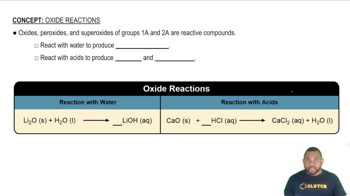
Oxide Reactions
Pratica correlata
Domanda del libro di testo

If hydrogen were used as a fuel, it could be burned according to this reaction: H2(g) + 1/2 O2(g) → H2O(g) Use average bond energies to calculate ΔHrxn for this reaction.

676
views

Domanda del libro di testo

Draw the Lewis structure for urea, H2NCONH2, one of the compounds responsible for the smell of urine. (The central carbon atom is bonded to both nitrogen atoms and to the oxygen atom.) Does urea contain polar bonds? Which bond in urea is most polar?

1666
views
Domanda del libro di testo

Some theories of aging suggest that free radicals cause certain diseases and perhaps aging in general. As you know from the Lewis model, such molecules are not chemically stable and will quickly react with other molecules. According to certain theories, free radicals may attack molecules within the cell, such as DNA, changing them and causing cancer or other diseases. Free radicals may also attack molecules on the surfaces of cells, making them appear foreign to the body's immune system. The immune system then attacks the cells and destroys them, weakening the body. Draw Lewis structures for each free radical implicated in this theory of aging. d. CH3OO (unpaired electron on terminal oxygen)

580
views
Domanda del libro di testo

Free radicals are important in many environmentally significant reactions (see the Chemistry in the Environment box on free radicals in this chapter). For example, photochemical smog— smog that results from the action of sunlight on air pollutants— forms in part by these two steps:

The product of this reaction, ozone, is a pollutant in the lower atmosphere. (Upper atmospheric ozone is a natural part of the atmosphere that protects life on Earth from ultraviolet light.) Ozone is an eye and lung irritant and also accelerates the weathering of rubber products. Rewrite the given reactions using the Lewis structure of each reactant and product. Identify the free radicals.

552
views