
Ch.9 - Chemical Bonding I: The Lewis Model
Tro - Chemistry: A Molecular Approach 4th Edition
Tro4th EditionChemistry: A Molecular ApproachISBN: 9780134112831Non è quello che usi tu?Cambia libro di testo
Capitolo 9, Problema 93

The reaction of Fe2O3(s) with Al(s) to form Al2O3(s) and Fe(s) is called the thermite reaction and is highly exothermic. What role does lattice energy play in the exothermicity of the reaction?

Guida verificata passo dopo passo
1
Understand that lattice energy is the energy released when ions in the gas phase form an ionic solid. It is a measure of the strength of the forces holding the ions together in the solid.
In the thermite reaction, Fe2O3(s) and Al(s) react to form Al2O3(s) and Fe(s). The reaction can be represented as: \[ \text{Fe}_2\text{O}_3(s) + 2\text{Al}(s) \rightarrow \text{Al}_2\text{O}_3(s) + 2\text{Fe}(s) \]
Consider the lattice energy of the reactants and products. The lattice energy of Al2O3 is significantly higher than that of Fe2O3, meaning that more energy is released when Al2O3 forms compared to the energy required to break the lattice of Fe2O3.
The high lattice energy of Al2O3 contributes to the overall exothermic nature of the reaction. The formation of a more stable ionic compound (Al2O3) releases a large amount of energy, which is a key factor in the exothermicity of the thermite reaction.
Conclude that the difference in lattice energies between the reactants and products is a major contributor to the exothermic nature of the thermite reaction, as the formation of Al2O3 releases more energy than is consumed in breaking the bonds of Fe2O3.

Risposta video verificata per un problema simile:

Questa soluzione video è stata consigliata dai nostri tutor come utile per risolvere questo problema.
Durata del video:
4m

Concetti chiave

Ecco i concetti essenziali che devi comprendere per rispondere correttamente alla domanda.

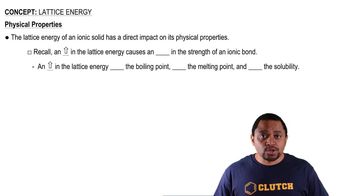
Lattice Energy

Lattice energy is the energy released when gaseous ions combine to form an ionic solid. It is a measure of the strength of the forces between the ions in an ionic compound. In the context of the thermite reaction, the formation of Al2O3 from Al and O2 involves the release of significant lattice energy, contributing to the overall exothermic nature of the reaction.
Video consigliato:

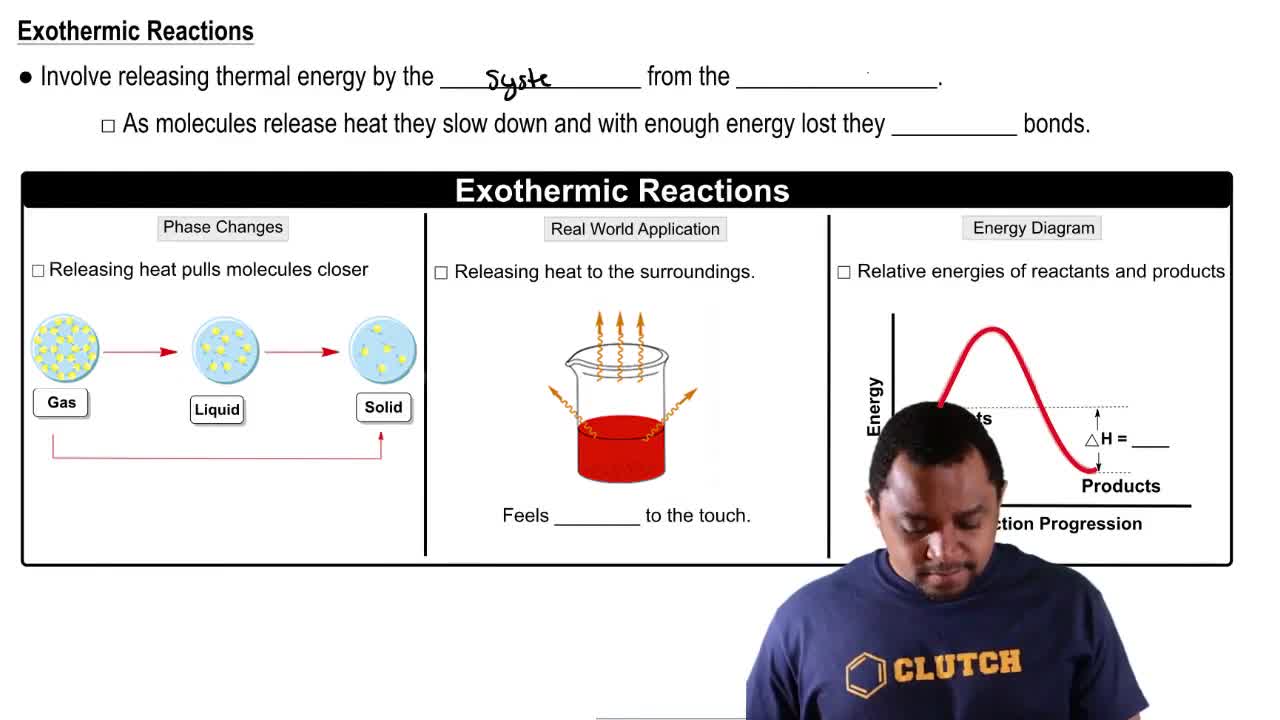
Exothermic Reactions

Exothermic reactions are chemical reactions that release energy, usually in the form of heat, to the surroundings. The thermite reaction is a classic example, where the energy released from the formation of stable products (like Al2O3 and Fe) is greater than the energy required to break the bonds in the reactants. This energy difference is what drives the reaction forward and results in a temperature increase.
Video consigliato:
Percorso guidato
02:38
Endothermic & Exothermic Reactions

Thermodynamics of Chemical Reactions

Thermodynamics in chemistry involves the study of energy changes during chemical reactions. Key principles include the concepts of enthalpy, entropy, and Gibbs free energy. In the thermite reaction, the high negative enthalpy change indicates that the products are more stable than the reactants, and the significant lattice energy released upon product formation is a crucial factor in understanding the reaction's exothermicity.
Video consigliato:
Percorso guidato
01:18
First Law of Thermodynamics