Ch.1 - Matter, Measurement & Problem Solving
Tro - Chemistry: A Molecular Approach 5th Edition
Tro5th EditionChemistry: A Molecular ApproachISBN: 9780134874371Non è quello che usi tu?Cambia libro di testo
Capitolo 1, Problema 38

Classify each substance as a pure substance or a mixture. If it is a pure substance, classify it as an element or a compound. If it is a mixture, classify it as homogeneous or heterogeneous. a. wine b. beef stew c. iron d. carbon monoxide

Guida verificata passo dopo passo
1
Identify the characteristics of a pure substance: it has a uniform and definite composition. Pure substances can be elements or compounds.
Identify the characteristics of a mixture: it consists of two or more substances physically combined. Mixtures can be homogeneous (uniform composition) or heterogeneous (non-uniform composition).
Classify 'wine': Wine is a mixture of water, alcohol, and other components. It is homogeneous because its composition is uniform throughout.
Classify 'beef stew': Beef stew is a mixture of various ingredients like meat, vegetables, and broth. It is heterogeneous because its composition is not uniform throughout.
Classify 'iron' and 'carbon monoxide': Iron is a pure substance and an element, as it consists of only one type of atom. Carbon monoxide is a pure substance and a compound, as it consists of two different elements chemically combined.

Risposta video verificata per un problema simile:

Questa soluzione video è stata consigliata dai nostri tutor come utile per risolvere questo problema.

Concetti chiave

Ecco i concetti essenziali che devi comprendere per rispondere correttamente alla domanda.

Pure Substances vs. Mixtures

A pure substance consists of a single type of particle and has a uniform composition throughout, while a mixture contains two or more different substances that retain their individual properties. Pure substances can be further classified into elements, which are made of one type of atom, and compounds, which are made of two or more types of atoms chemically bonded together.
Video consigliato:
Percorso guidato
01:03
Solubility and Mixtures

Homogeneous vs. Heterogeneous Mixtures

Homogeneous mixtures have a uniform composition and appearance throughout, meaning that the individual components are not distinguishable. In contrast, heterogeneous mixtures contain visibly different substances or phases, allowing the individual components to be identified. This distinction is crucial for classifying mixtures accurately.
Video consigliato:
Percorso guidato
01:03
Solubility and Mixtures

Classification of Elements and Compounds

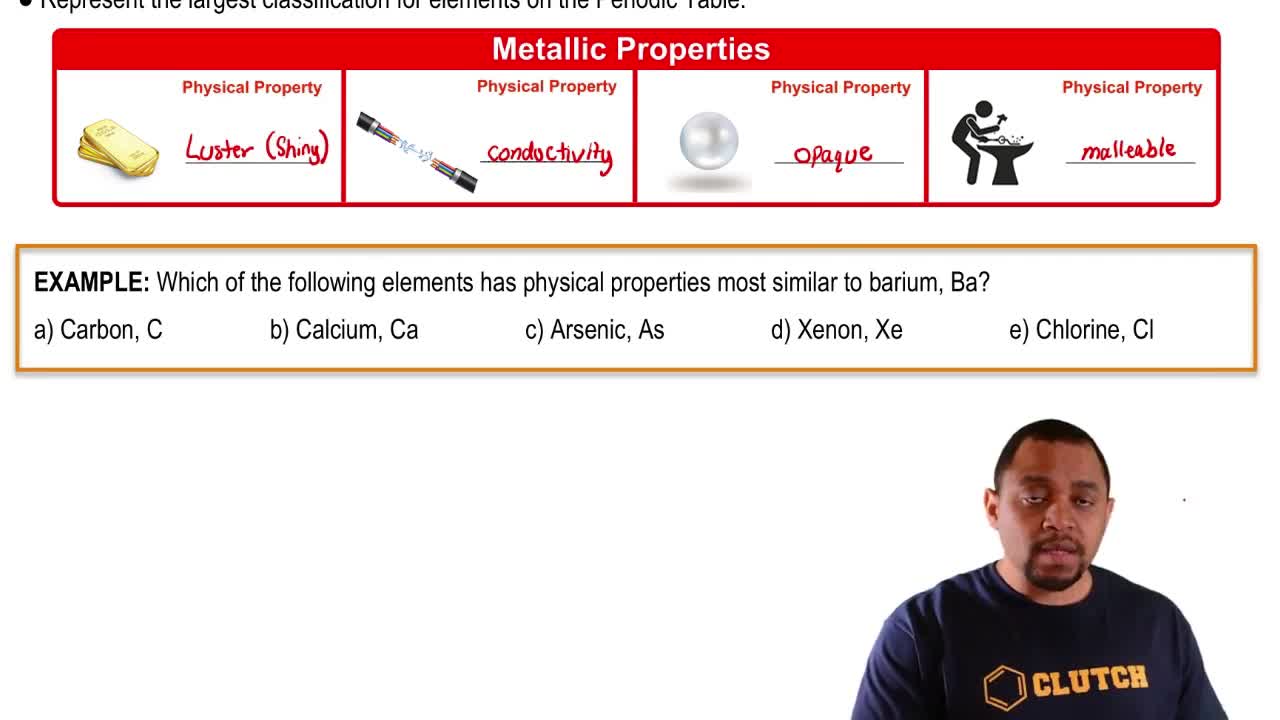
Elements are the simplest form of matter that cannot be broken down into simpler substances by chemical means, while compounds are substances formed when two or more elements chemically combine in fixed ratios. Understanding this classification helps in identifying whether a substance is a pure element or a compound, which is essential for the question at hand.
Video consigliato:
Percorso guidato
01:39
Element Classification Example