Ch.1 - Matter, Measurement & Problem Solving
Tro - Chemistry: A Molecular Approach 5th Edition
Tro5th EditionChemistry: A Molecular ApproachISBN: 9780134874371Non è quello che usi tu?Cambia libro di testo
Capitolo 1, Problema 63

How many 1-cm squares would it take to construct a square that is 1 m on each side?

Guida verificata passo dopo passo
1
Convert the side length of the larger square from meters to centimeters. Since 1 meter equals 100 centimeters, the side length of the larger square is 100 cm.
Determine the area of the larger square using the formula for the area of a square: \( \text{Area} = \text{side length}^2 \).
Calculate the area of the larger square: \( 100 \text{ cm} \times 100 \text{ cm} \).
Determine the area of one 1-cm square, which is \( 1 \text{ cm} \times 1 \text{ cm} = 1 \text{ cm}^2 \).
Divide the area of the larger square by the area of one 1-cm square to find the number of 1-cm squares needed.

Risposta video verificata per un problema simile:

Questa soluzione video è stata consigliata dai nostri tutor come utile per risolvere questo problema.
Durata del video:
3m

Concetti chiave

Ecco i concetti essenziali che devi comprendere per rispondere correttamente alla domanda.

Unit Conversion

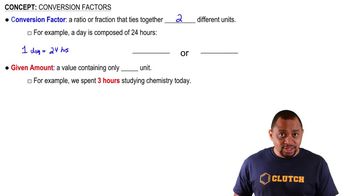
Unit conversion is the process of converting a quantity expressed in one set of units to another. In this question, it is essential to convert meters to centimeters, as the dimensions of the square are given in different units. Knowing that 1 meter equals 100 centimeters allows for accurate calculations when determining the area.
Video consigliato:
Percorso guidato
01:56
Conversion Factors

Area Calculation

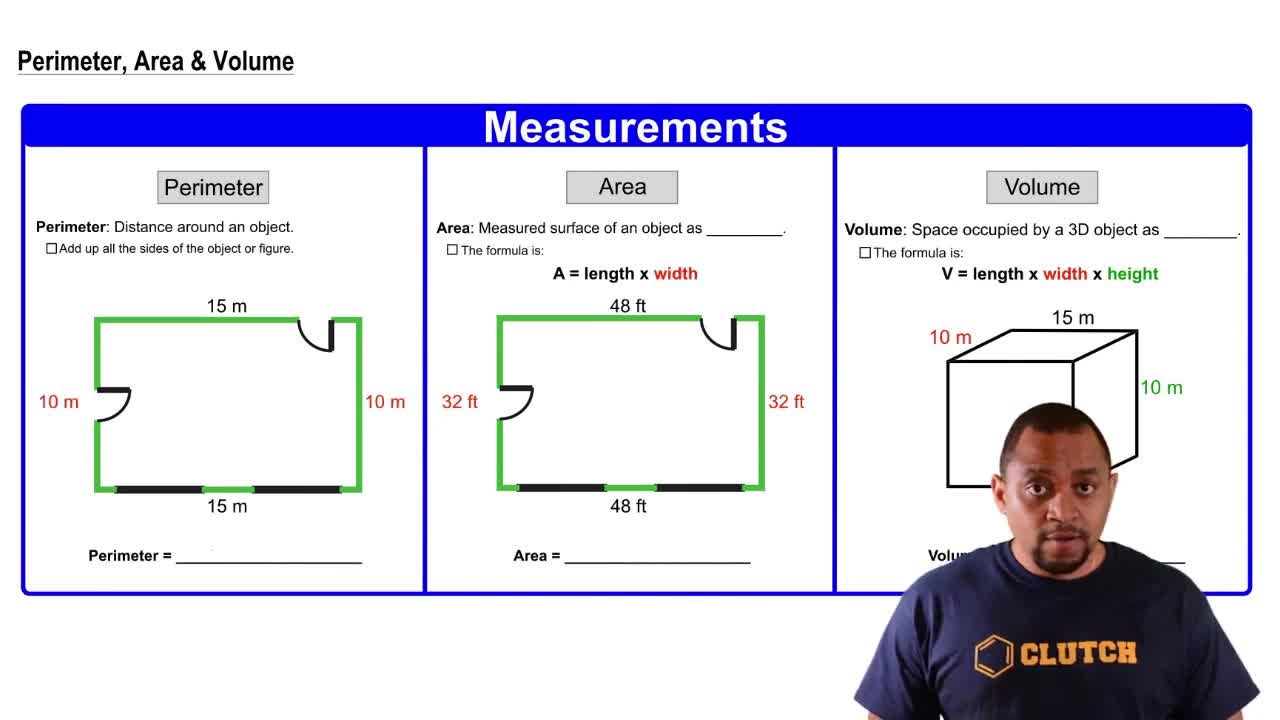
Area calculation involves determining the amount of space within a two-dimensional shape. For a square, the area is calculated by squaring the length of one side. In this case, the area of a 1 m square can be found by first converting the side length to centimeters and then applying the formula for area (side length squared).
Video consigliato:
Percorso guidato
03:47
Perimeter, Area, Volume

Tiling or Packing Problems

Tiling or packing problems involve determining how many smaller units can fit into a larger area without gaps or overlaps. In this scenario, the question asks how many 1-cm squares fit into the area of a larger square. Understanding this concept helps in visualizing the arrangement and calculating the total number of smaller squares needed.
Video consigliato:
Percorso guidato
01:41
Cubic Unit Cells