Ch.10 - Chemical Bonding I: The Lewis Model
Tro - Chemistry: A Molecular Approach 5th Edition
Tro5th EditionChemistry: A Molecular ApproachISBN: 9780134874371Non è quello che usi tu?Cambia libro di testo
Capitolo 10, Problema 114

A compound composed of only carbon and chlorine is 85.5% chlorine by mass. Propose a Lewis structure for the compound.

Guida verificata passo dopo passo
1
Determine the mass percentage of carbon in the compound by subtracting the mass percentage of chlorine from 100%. This gives you the mass percentage of carbon.
Assume a sample size of 100 grams to simplify calculations. This assumption means that the mass of chlorine in the compound is 85.5 grams and the mass of carbon is the remainder.
Convert the mass of each element to moles by using their respective molar masses. The molar mass of chlorine (Cl) is approximately 35.5 g/mol, and the molar mass of carbon (C) is approximately 12.0 g/mol.
Calculate the simplest whole number ratio of moles of carbon to moles of chlorine in the compound. This ratio will help in determining the empirical formula of the compound.
Use the empirical formula to propose a Lewis structure. Remember that carbon typically forms four bonds in neutral compounds, and chlorine usually forms one bond. Arrange the atoms to satisfy these bonding preferences and to achieve a neutral overall charge.

Risposta video verificata per un problema simile:

Questa soluzione video è stata consigliata dai nostri tutor come utile per risolvere questo problema.

Concetti chiave

Ecco i concetti essenziali che devi comprendere per rispondere correttamente alla domanda.

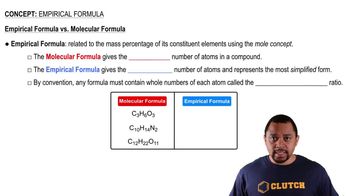
Empirical Formula

The empirical formula represents the simplest whole-number ratio of elements in a compound. In this case, knowing that the compound is 85.5% chlorine by mass allows us to determine the ratio of carbon to chlorine, which is essential for proposing a Lewis structure.
Video consigliato:
Percorso guidato
02:26
Empirical vs Molecular Formula

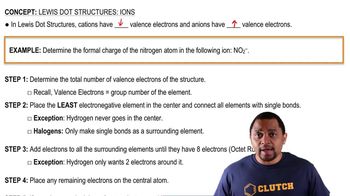
Lewis Structures

Lewis structures are diagrams that represent the bonding between atoms in a molecule and the lone pairs of electrons. They help visualize how atoms are connected and the distribution of electrons, which is crucial for understanding the compound's chemical behavior and stability.
Video consigliato:
Percorso guidato
04:28
Lewis Dot Structures: Ions

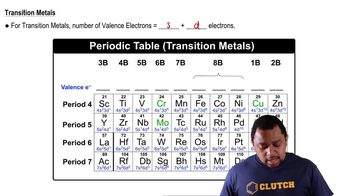
Valence Electrons

Valence electrons are the outermost electrons of an atom and are involved in forming bonds. Knowing the number of valence electrons for carbon and chlorine is vital for accurately drawing the Lewis structure, as it determines how atoms will bond and share electrons.
Video consigliato:
Percorso guidato
02:12
Transition Metals Valence Electrons