

Ch.10 - Chemical Bonding I: The Lewis Model
Tro - Chemistry: A Molecular Approach 5th Edition
Tro5th EditionChemistry: A Molecular ApproachISBN: 9780134874371Non è quello che usi tu?Cambia libro di testo
Capitolo 10, Problema 95

Draw the Lewis structure for nitric acid, ensuring the hydrogen atom is attached to one of the oxygen atoms. Include all three resonance structures by alternating the double bond among the three oxygen atoms. Use formal charge to determine which of the resonance structures is most important to the structure of nitric acid.

Guida verificata passo dopo passo
1
Identify the total number of valence electrons in nitric acid (HNO₃). Hydrogen has 1, nitrogen has 5, and each oxygen has 6, giving a total of 24 valence electrons.
Draw the skeletal structure of HNO₃ with nitrogen as the central atom, bonded to one hydrogen and three oxygen atoms. Initially, connect each atom with single bonds.
Distribute the remaining valence electrons to satisfy the octet rule for each atom, starting with the outer atoms (oxygen) and then the central atom (nitrogen).
Create double bonds between nitrogen and one of the oxygen atoms to satisfy the octet rule for nitrogen. Repeat this process to form the three resonance structures by alternating the double bond among the three oxygen atoms.
Calculate the formal charge for each atom in all three resonance structures. The most stable resonance structure will have the formal charges closest to zero, with negative charges on the more electronegative atoms (oxygen).

Concetti chiave

Ecco i concetti essenziali che devi comprendere per rispondere correttamente alla domanda.

Lewis Structures

Lewis structures are diagrams that represent the bonding between atoms in a molecule and the lone pairs of electrons that may exist. They use dots to represent valence electrons and lines to represent bonds. In the case of nitric acid, the Lewis structure will show how the hydrogen atom is bonded to one of the oxygen atoms, and how the remaining oxygen atoms are connected through double and single bonds.
Video consigliato:
Percorso guidato
04:28
Lewis Dot Structures: Ions

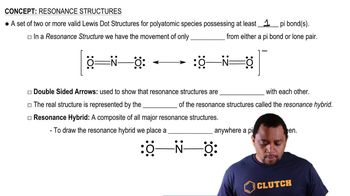
Resonance Structures

Resonance structures are different ways of drawing the same molecule that illustrate the delocalization of electrons. In nitric acid, resonance structures show how the double bond can shift among the three oxygen atoms. This concept is crucial for understanding the actual electron distribution in the molecule, which is a hybrid of all possible resonance forms.
Video consigliato:
Percorso guidato
01:42
Resonance Structures

Formal Charge

Formal charge is a theoretical charge assigned to an atom in a molecule, calculated based on the number of valence electrons, the number of bonds, and the number of lone electrons. It helps determine the most stable resonance structure by indicating which structure has the lowest formal charges on the atoms. In nitric acid, analyzing formal charges allows us to identify which resonance structure contributes most to the overall structure of the molecule.
Video consigliato:
Pratica correlata
Domanda del libro di testo

Diazomethane is a highly poisonous, explosive compound because it readily evolves N2. Diazomethane has the following composition by mass: 28.57% C; 4.80% H; and 66.64% N. The molar mass of diazomethane is 42.04 g/mol. Find the molecular formula of diazomethane, draw its Lewis structure, and assign formal charges to each atom. Why is diazomethane not very stable? Explain.

818
views
Domanda del libro di testo

NaCl has a lattice energy of -787 kJ/mol. Consider a hypothetical salt XY. X3+ has the same radius of Na+ and Y3- has the same radius as Cl-. Estimate the lattice energy of XY.

1192
views
Domanda del libro di testo

Draw the Lewis structure for each organic compound from its condensed structural formula. b. CH3OCH3

558
views
Domanda del libro di testo

The cyanate ion (OCN- ) and the fulminate ion (CNO- ) share the same three atoms but have vastly different properties. The cyanate ion is stable, while the fulminate ion is unstable and forms explosive compounds. The resonance structures of the cyanate ion are explored in Example 10.8. Draw Lewis structures for the fulminate ion—including possible resonance forms— and use formal charge to explain why the fulminate ion is less stable (and therefore more reactive) than the cyanate ion.

1
views
Domanda del libro di testo

The reaction of Fe2O3(s) with Al(s) to form Al2O3(s) and Fe(s) is called the thermite reaction and is highly exothermic. What role does lattice energy play in the exothermicity of the reaction?

1197
views