Ch.10 - Chemical Bonding I: The Lewis Model
Tro - Chemistry: A Molecular Approach 5th Edition
Tro5th EditionChemistry: A Molecular ApproachISBN: 9780134874371Non è quello che usi tu?Cambia libro di testo
Capitolo 10, Problema 68

In N2O, nitrogen is the central atom and the oxygen atom is terminal. In OF2, however, oxygen is the central atom. Use formal charges to explain why.

Guida verificata passo dopo passo
1
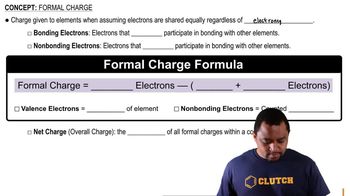
insert step 1> Identify the formal charge formula: Formal charge = (Valence electrons) - (Non-bonding electrons) - (Bonding electrons/2).
insert step 2> Calculate the formal charges for each atom in N2O with nitrogen as the central atom: Consider the possible Lewis structures and calculate the formal charges for nitrogen and oxygen.
insert step 3> Calculate the formal charges for each atom in OF2 with oxygen as the central atom: Consider the possible Lewis structures and calculate the formal charges for oxygen and fluorine.
insert step 4> Compare the formal charges: The most stable structure is the one where the formal charges are minimized and closest to zero.
insert step 5> Explain the stability: In N2O, having nitrogen as the central atom results in a more stable structure with minimized formal charges, whereas in OF2, oxygen as the central atom results in minimized formal charges, explaining the observed structures.

Risposta video verificata per un problema simile:

Questa soluzione video è stata consigliata dai nostri tutor come utile per risolvere questo problema.
Durata del video:
3m

Concetti chiave

Ecco i concetti essenziali che devi comprendere per rispondere correttamente alla domanda.

Formal Charge

Formal charge is a theoretical charge assigned to an atom in a molecule, calculated based on the number of valence electrons, the number of bonds, and the number of non-bonding electrons. It helps in determining the most stable structure of a molecule by minimizing the formal charges across all atoms. A lower formal charge on an atom generally indicates a more stable configuration.
Video consigliato:

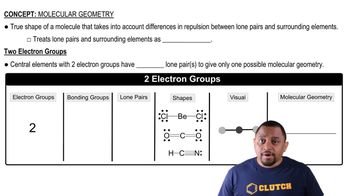
Molecular Geometry

Molecular geometry refers to the three-dimensional arrangement of atoms within a molecule. The central atom's position and the surrounding atoms influence the overall shape, which can affect the molecule's reactivity and properties. Understanding molecular geometry is crucial for predicting how atoms will bond and interact in different compounds.
Video consigliato:
Percorso guidato
01:33
Molecular Geometry with Two Electron Groups

Central vs. Terminal Atoms

In a molecule, central atoms are typically bonded to multiple other atoms, while terminal atoms are usually bonded to only one other atom. The choice of which atom is central can affect the distribution of electrons and the overall stability of the molecule. In the case of N2O and OF2, the central atom's identity influences the formal charge calculations, leading to different preferred structures.
Video consigliato: