Ch.10 - Chemical Bonding I: The Lewis Model
Tro - Chemistry: A Molecular Approach 5th Edition
Tro5th EditionChemistry: A Molecular ApproachISBN: 9780134874371Non è quello che usi tu?Cambia libro di testo
Capitolo 10, Problema 108

The azide ion, N3-, is a symmetrical ion, all of whose contributing resonance structures have formal charges. Draw three important contributing structures for this ion.

Guida verificata passo dopo passo
1
Identify the total number of valence electrons in the azide ion, \( \text{N}_3^- \). Nitrogen has 5 valence electrons, and there are three nitrogen atoms, plus one extra electron due to the negative charge, giving a total of 16 valence electrons.
Distribute the electrons to form bonds between the nitrogen atoms. Start by connecting the three nitrogen atoms in a linear arrangement: \( \text{N} - \text{N} - \text{N} \).
Assign electrons to form double or triple bonds between the nitrogen atoms to satisfy the octet rule for each atom, while keeping the total number of electrons at 16.
Calculate the formal charge for each nitrogen atom in each resonance structure using the formula: \( \text{Formal Charge} = \text{Valence Electrons} - \text{Non-bonding Electrons} - \frac{1}{2} \times \text{Bonding Electrons} \).
Draw the three resonance structures, ensuring that the sum of the formal charges equals the overall charge of the ion, which is -1.

Risposta video verificata per un problema simile:

Questa soluzione video è stata consigliata dai nostri tutor come utile per risolvere questo problema.
Durata del video:
4m

Concetti chiave

Ecco i concetti essenziali che devi comprendere per rispondere correttamente alla domanda.

Resonance Structures

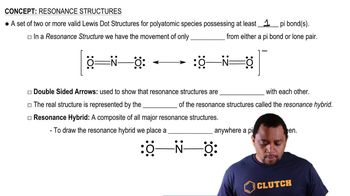
Resonance structures are different ways of drawing a molecule or ion that represent the same arrangement of atoms but differ in the distribution of electrons. For the azide ion (N3-), these structures help illustrate how the electrons can be delocalized across the molecule, contributing to its overall stability. Each resonance structure must obey the rules of valence and maintain the same number of electrons.
Video consigliato:
Percorso guidato
01:42
Resonance Structures

Formal Charge

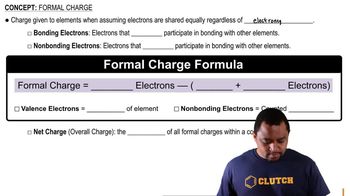
Formal charge is a theoretical charge assigned to an atom in a molecule, calculated based on the number of valence electrons, the number of non-bonding electrons, and half the number of bonding electrons. It helps in determining the most stable resonance structure, as structures with formal charges closer to zero are generally more favorable. In the case of the azide ion, understanding formal charges is crucial for drawing accurate resonance structures.
Video consigliato:

Symmetry in Ions

Symmetry in ions refers to the uniform distribution of charge and structure, which can influence the stability and reactivity of the ion. The azide ion (N3-) is symmetrical, meaning its resonance structures will reflect this symmetry, leading to equivalent contributions from each structure. Recognizing symmetry helps predict the behavior of the ion in chemical reactions and its interactions with other species.
Video consigliato: