
Ch.11 - Chemical Bonding II: Molecular Shapes, VSEPR & MO Theory
Tro - Chemistry: A Molecular Approach 5th Edition
Tro5th EditionChemistry: A Molecular ApproachISBN: 9780134874371Non è quello che usi tu?Cambia libro di testo
Capitolo 11, Problema 91

Draw a molecular orbital energy diagram for ClF. (Assume that the sp orbitals are lower in energy than the p orbitals.) What is the bond order in ClF?

Guida verificata passo dopo passo
1
Identify the atomic orbitals involved: Chlorine (Cl) and Fluorine (F) both have valence electrons in the 3p and 2p orbitals, respectively.
Construct the molecular orbital (MO) diagram: Start by placing the atomic orbitals of Cl and F on either side of the diagram. Since Cl is less electronegative than F, its atomic orbitals will be slightly higher in energy.
Combine the atomic orbitals to form molecular orbitals: The 3s and 2s orbitals will combine to form σ and σ* molecular orbitals. The 3p and 2p orbitals will combine to form σ, π, π*, and σ* molecular orbitals.
Fill the molecular orbitals with electrons: ClF has a total of 14 valence electrons. Fill the molecular orbitals starting from the lowest energy level, following the Pauli exclusion principle and Hund's rule.
Calculate the bond order: Use the formula \( \text{Bond Order} = \frac{(\text{Number of electrons in bonding MOs} - \text{Number of electrons in antibonding MOs})}{2} \) to determine the bond order of ClF.

Risposta video verificata per un problema simile:

Questa soluzione video è stata consigliata dai nostri tutor come utile per risolvere questo problema.
Durata del video:
6m

Concetti chiave

Ecco i concetti essenziali che devi comprendere per rispondere correttamente alla domanda.

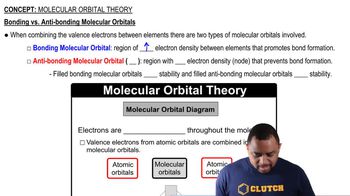
Molecular Orbital Theory

Molecular Orbital Theory describes how atomic orbitals combine to form molecular orbitals, which can be occupied by electrons. In this theory, electrons are delocalized over the entire molecule rather than being confined to individual atoms. The energy levels of these molecular orbitals are determined by the energies of the atomic orbitals involved in their formation, influencing the stability and reactivity of the molecule.
Video consigliato:
Percorso guidato
03:06
Molecular Orbital Theory

Bond Order

Bond order is a measure of the number of chemical bonds between a pair of atoms. It is calculated as the difference between the number of bonding and antibonding electrons divided by two. A higher bond order indicates a stronger bond and greater stability of the molecule. In the case of ClF, determining the bond order involves analyzing the molecular orbital diagram to count the electrons in bonding and antibonding orbitals.
Video consigliato:
Percorso guidato
00:36
Average Bond Order

Energy Levels of Orbitals

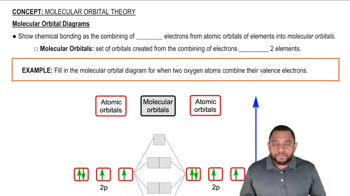
The energy levels of atomic and molecular orbitals dictate how electrons are arranged in a molecule. In ClF, it is assumed that sp orbitals are lower in energy than p orbitals, which affects the arrangement of electrons in the molecular orbital diagram. Understanding these energy levels is crucial for predicting the stability and bond characteristics of the molecule, as they influence the filling of molecular orbitals and the resulting bond order.
Video consigliato:
Percorso guidato
04:12
Molecular Orbital Diagram
Pratica correlata
Domanda del libro di testo

Water does not easily remove grease from dishes or hands because grease is nonpolar and water is polar. The addition of soap to water, however, allows the grease to dissolve. Study the structure of sodium stearate (a soap) and describe how it works.

1244
views
Domanda del libro di testo

Most vitamins can be classified as either fat soluble, which results in their tendency to accumulate in the body (so that taking too much can be harmful), or water soluble, which results in their tendency to be quickly eliminated from the body in urine. Examine the structural formulas and space-filling models of these vitamins and determine whether each one is fat soluble (mostly nonpolar) or water soluble (mostly polar). (a) vitamin C

876
views
Domanda del libro di testo

Most vitamins can be classified as either fat soluble, which results in their tendency to accumulate in the body (so that taking too much can be harmful), or water soluble, which results in their tendency to be quickly eliminated from the body in urine. Examine the structural formulas and space-filling models of these vitamins and determine whether each one is fat soluble (mostly nonpolar) or water soluble (mostly polar). (c) niacin (vitamin B3)

822
views
Domanda del libro di testo

The compound C3H4 has two double bonds. Describe its bonding and geometry, using a valence bond approach.

2441
views
Domanda del libro di testo

Draw Lewis structures and MO diagrams for CN+ , CN, and CN- . According to the Lewis model, which species is most stable?

1697
views
1
comments