
Ch.11 - Chemical Bonding II: Molecular Shapes, VSEPR & MO Theory
Tro - Chemistry: A Molecular Approach 5th Edition
Tro5th EditionChemistry: A Molecular ApproachISBN: 9780134874371Non è quello che usi tu?Cambia libro di testo
Capitolo 11, Problema 73

Sketch the bonding and antibonding molecular orbitals that result from linear combinations of the 2px atomic orbitals in a homonuclear diatomic molecule. (The 2px orbitals are those whose lobes are oriented along the bonding axis.)

Guida verificata passo dopo passo
1
Identify the 2px atomic orbitals on each atom in the homonuclear diatomic molecule. These orbitals are oriented along the x-axis, which is the bonding axis in this scenario.
Understand the concept of linear combination of atomic orbitals (LCAO) which forms molecular orbitals. In this process, atomic orbitals combine constructively to form bonding orbitals and destructively to form antibonding orbitals.
Visualize the constructive combination of the 2px orbitals. When the lobes of the same sign (positive or negative) from each 2px orbital overlap along the bonding axis, a bonding molecular orbital (σ2px) is formed. This orbital has increased electron density along the axis connecting the two nuclei, which helps in bonding the atoms together.
Visualize the destructive combination of the 2px orbitals. When the lobes of opposite signs from each 2px orbital overlap, an antibonding molecular orbital (σ*2px) is formed. This orbital has a node (a region of zero electron density) between the nuclei, which weakens the bond between the atoms.
Sketch the resulting molecular orbitals. The bonding orbital (σ2px) should be drawn with increased electron density between the nuclei, and the antibonding orbital (σ*2px) should be drawn with a node between the nuclei and less electron density along the bonding axis.

Risposta video verificata per un problema simile:

Questa soluzione video è stata consigliata dai nostri tutor come utile per risolvere questo problema.
Durata del video:
3m

Concetti chiave

Ecco i concetti essenziali che devi comprendere per rispondere correttamente alla domanda.

Molecular Orbitals

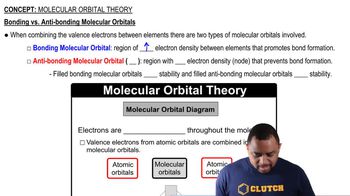
Molecular orbitals (MOs) are formed when atomic orbitals combine through linear combinations. In diatomic molecules, this process leads to the formation of bonding and antibonding orbitals. Bonding orbitals are lower in energy and stabilize the molecule, while antibonding orbitals are higher in energy and can destabilize it if occupied.
Video consigliato:
Percorso guidato
03:06
Molecular Orbital Theory

Linear Combination of Atomic Orbitals (LCAO)

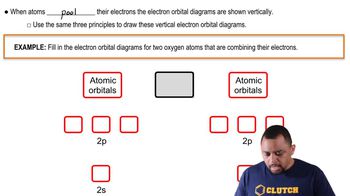
The Linear Combination of Atomic Orbitals (LCAO) is a method used to construct molecular orbitals from atomic orbitals. For homonuclear diatomic molecules, the 2px atomic orbitals combine to form one bonding molecular orbital and one antibonding molecular orbital. This approach helps predict the electronic structure and properties of molecules.
Video consigliato:
Percorso guidato
01:51
Atomic Orbitals Example

Bonding and Antibonding Orbitals

Bonding orbitals are formed when atomic orbitals combine constructively, resulting in increased electron density between the nuclei, which stabilizes the molecule. Antibonding orbitals, on the other hand, arise from destructive interference, leading to a node between the nuclei and higher energy, which can weaken or prevent bond formation if occupied.
Video consigliato:
Percorso guidato
03:06
Molecular Orbital Theory
Pratica correlata
Domanda del libro di testo

Using the molecular orbital energy ordering for second-row homonuclear diatomic molecules in which the π2p orbitals lie at lower energy than the σ2p, draw MO energy diagrams and predict the bond order in a molecule or ion with each number of total valence electrons. Will the molecule or ion be diamagnetic or paramagnetic? a. 4 b. 6

332
views
Domanda del libro di testo

Sketch the bonding molecular orbital that results from the linear combination of two 1s orbitals. Indicate the region where interference occurs and state the kind of interference (constructive or destructive).

1214
views
Domanda del libro di testo

Sketch the bonding and antibonding molecular orbitals that result from linear combinations of the 2pz atomic orbitals in a homonuclear diatomic molecule. (The 2pz orbitals are those whose lobes are oriented perpendicular to the bonding axis.) How do these molecular orbitals differ from those obtained from linear combinations of the 2py atomic orbitals? (The 2py orbitals are also oriented perpendicular to the bonding axis, but also perpendicular to the 2pz orbitals.)

817
views
Domanda del libro di testo

Draw an MO energy diagram and predict the bond order of Li2+ and Li2-. Do you expect these molecules to exist in the gas phase?

2618
views
Domanda del libro di testo

Draw an MO energy diagram and predict the bond order of Be2+ and Be2- . Do you expect these molecules to exist in the gas phase?

3726
views
1
comments
Domanda del libro di testo

Using the molecular orbital energy ordering for second-row homonuclear diatomic molecules in which the π2p orbitals lie at lower energy than the σ2p, draw MO energy diagrams and predict the bond order in a molecule or ion with each number of total valence electrons. Will the molecule or ion be diamagnetic or paramagnetic? c. 8

505
views