Ch.12 - Liquids, Solids & Intermolecular Forces
Tro - Chemistry: A Molecular Approach 5th Edition
Tro5th EditionChemistry: A Molecular ApproachISBN: 9780134874371Non è quello che usi tu?Cambia libro di testo
Capitolo 12, Problema 36a

Determine the kinds of intermolecular forces that are present in each element or compound. a. Kr

Guida verificata passo dopo passo
1
Step 1: Identify the type of molecule. In this case, Krypton (Kr) is a noble gas, which means it is a monoatomic molecule.
Step 2: Understand the types of intermolecular forces. There are three main types: London dispersion forces, dipole-dipole interactions, and hydrogen bonding.
Step 3: Determine the type of intermolecular force. Monoatomic molecules like Kr do not have dipole-dipole interactions or hydrogen bonding because these forces require the molecule to be polar or contain hydrogen bonded to a highly electronegative atom (N, O, or F), respectively.
Step 4: By process of elimination, the only type of intermolecular force that can exist in Kr is London dispersion forces. These forces are present in all molecules and atoms, and are the result of temporary fluctuations in electron distribution around an atom or molecule, which create a temporary dipole that induces a dipole in neighboring atoms or molecules.
Step 5: Therefore, the type of intermolecular force present in Kr is London dispersion forces.

Risposta video verificata per un problema simile:

Questa soluzione video è stata consigliata dai nostri tutor come utile per risolvere questo problema.
Durata del video:
24s

Concetti chiave

Ecco i concetti essenziali che devi comprendere per rispondere correttamente alla domanda.

Intermolecular Forces

Intermolecular forces are the attractive forces between molecules that influence physical properties such as boiling and melting points. They include hydrogen bonding, dipole-dipole interactions, and London dispersion forces. Understanding these forces is crucial for predicting the behavior of substances in different states of matter.
Video consigliato:
Percorso guidato
01:59
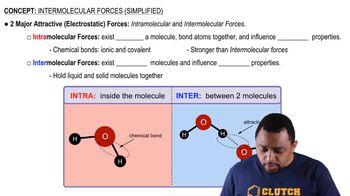
Intermolecular vs Intramolecular Forces

Noble Gases

Noble gases, such as krypton (Kr), are elements found in Group 18 of the periodic table. They are characterized by their full valence electron shells, making them largely inert and nonpolar. The primary intermolecular force present in noble gases is London dispersion forces, which arise from temporary dipoles created by electron movement.
Video consigliato:
Percorso guidato
00:44
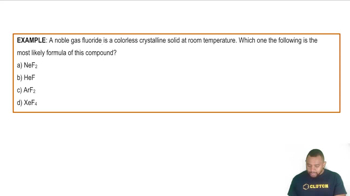
Noble Gas Compounds Example

London Dispersion Forces

London dispersion forces are weak intermolecular forces that occur due to temporary fluctuations in electron density within molecules or atoms. These forces are present in all substances, but they are the only type of intermolecular force in nonpolar molecules, such as noble gases. The strength of these forces increases with the size and polarizability of the atoms involved.
Video consigliato:
Percorso guidato
06:44
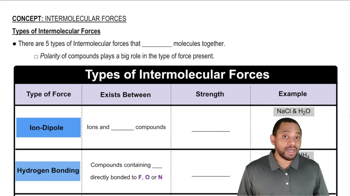
Types of Intermolecular Forces