Ch.12 - Liquids, Solids & Intermolecular Forces
Tro - Chemistry: A Molecular Approach 5th Edition
Tro5th EditionChemistry: A Molecular ApproachISBN: 9780134874371Non è quello che usi tu?Cambia libro di testo
Capitolo 12, Problema 45d

Determine whether each pair of compounds forms a homogeneous solution when combined. For those that form homogeneous solutions, indicate the type of forces that are involved. d. CH3CH2OH and H2O

Guida verificata passo dopo passo
1
Identify the polarity of each compound: CH3CH2OH (ethanol) is a polar molecule due to the presence of the hydroxyl group (-OH), and H2O (water) is also a polar molecule.
Consider the 'like dissolves like' principle in chemistry, which states that polar substances tend to dissolve well in other polar substances.
Since both ethanol and water are polar, they are likely to form a homogeneous solution when mixed.
Determine the type of intermolecular forces involved: Both ethanol and water can form hydrogen bonds due to the presence of hydrogen directly bonded to electronegative atoms (oxygen in both cases).
Conclude that ethanol and water will form a homogeneous solution primarily through hydrogen bonding.

Risposta video verificata per un problema simile:

Questa soluzione video è stata consigliata dai nostri tutor come utile per risolvere questo problema.
Durata del video:
1m

Concetti chiave

Ecco i concetti essenziali che devi comprendere per rispondere correttamente alla domanda.

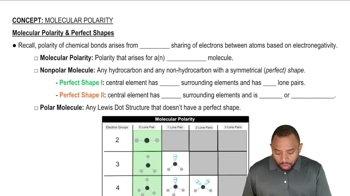
Polarity

Polarity refers to the distribution of electrical charge over the atoms in a molecule. Molecules with significant differences in electronegativity between their atoms, such as water (H2O) and ethanol (CH3CH2OH), exhibit polar characteristics. This polarity affects how substances interact with each other, influencing their ability to mix and form homogeneous solutions.
Video consigliato:
Percorso guidato
02:38
Molecular Polarity

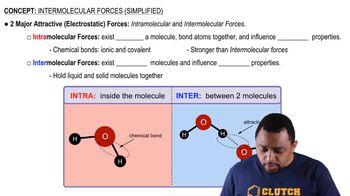
Intermolecular Forces

Intermolecular forces are the forces of attraction or repulsion between neighboring particles (atoms, molecules, or ions). In the case of CH3CH2OH and H2O, hydrogen bonding plays a crucial role, as both compounds can form hydrogen bonds due to the presence of hydroxyl (-OH) groups. These forces are essential for determining whether two substances will mix uniformly.
Video consigliato:
Percorso guidato
01:59
Intermolecular vs Intramolecular Forces

Solubility

Solubility is the ability of a substance to dissolve in a solvent, forming a homogeneous solution. The principle of 'like dissolves like' suggests that polar solvents, such as water, are more likely to dissolve polar solutes, like ethanol. Understanding solubility helps predict whether two compounds will form a homogeneous mixture when combined.
Video consigliato:
Percorso guidato
00:28
Solubility Rules