Ch.12 - Liquids, Solids & Intermolecular Forces
Tro - Chemistry: A Molecular Approach 5th Edition
Tro5th EditionChemistry: A Molecular ApproachISBN: 9780134874371Non è quello che usi tu?Cambia libro di testo
Capitolo 12, Problema 70

How much ice (in grams) would have to melt to lower the temperature of 352 mL of water from 25 °C to 5 °C? (Assume the density of water is 1.0 g/mL.)

Guida verificata passo dopo passo
1
Calculate the mass of the water using the formula: \( \text{mass} = \text{volume} \times \text{density} \). Since the density of water is 1.0 g/mL, the mass of 352 mL of water is 352 g.
Determine the amount of heat lost by the water as it cools from 25 °C to 5 °C using the formula: \( q = m \cdot c \cdot \Delta T \), where \( m \) is the mass of the water, \( c \) is the specific heat capacity of water (4.18 J/g°C), and \( \Delta T \) is the change in temperature.
Calculate \( \Delta T \) as the difference between the initial and final temperatures: \( \Delta T = 5 \text{ °C} - 25 \text{ °C} = -20 \text{ °C} \).
Use the heat lost by the water to determine the mass of ice that must melt. The heat absorbed by the ice is given by \( q = m_{\text{ice}} \cdot \Delta H_f \), where \( \Delta H_f \) is the heat of fusion of ice (334 J/g).
Set the heat lost by the water equal to the heat gained by the ice and solve for \( m_{\text{ice}} \): \( m \cdot c \cdot \Delta T = m_{\text{ice}} \cdot \Delta H_f \).

Risposta video verificata per un problema simile:

Questa soluzione video è stata consigliata dai nostri tutor come utile per risolvere questo problema.
Durata del video:
6m

Concetti chiave

Ecco i concetti essenziali che devi comprendere per rispondere correttamente alla domanda.

Heat Transfer

Heat transfer is the process of thermal energy moving from one object or substance to another due to a temperature difference. In this scenario, the heat lost by the water as it cools from 25 °C to 5 °C will be equal to the heat gained by the ice as it melts. Understanding this concept is crucial for calculating the amount of ice needed to absorb the heat released by the water.
Video consigliato:

Specific Heat Capacity

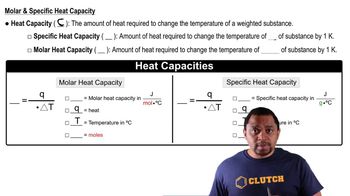
Specific heat capacity is the amount of heat required to raise the temperature of a unit mass of a substance by one degree Celsius. For water, the specific heat capacity is approximately 4.18 J/g°C. This concept is essential for determining how much energy is released by the water as it cools, which will help in calculating the mass of ice needed to absorb that energy.
Video consigliato:

Latent Heat of Fusion

Latent heat of fusion is the amount of heat energy required to change a substance from solid to liquid at its melting point without changing its temperature. For ice, this value is about 334 J/g. This concept is vital for understanding how much energy is needed to melt the ice, which will be compared to the energy lost by the water to find the required mass of ice.
Video consigliato: