Ch.12 - Liquids, Solids & Intermolecular Forces
Tro - Chemistry: A Molecular Approach 5th Edition
Tro5th EditionChemistry: A Molecular ApproachISBN: 9780134874371Non è quello che usi tu?Cambia libro di testo
Capitolo 12, Problema 62

This table displays the vapor pressure of nitrogen at several different temperatures. Use the data to determine the heat of vaporization and the normal boiling point of nitrogen. Temperature (K) Pressure (torr) 65 130.5 70 289.5 75 570.8 80 1028 85 1718

Guida verificata passo dopo passo
1
The Clausius-Clapeyron equation relates the vapor pressure of a substance to its temperature and is given by: \( \ln P = -\frac{\Delta H_{vap}}{R} \left( \frac{1}{T} \right) + C \), where \( P \) is the vapor pressure, \( \Delta H_{vap} \) is the heat of vaporization, \( R \) is the ideal gas constant (8.314 J/mol·K), \( T \) is the temperature in Kelvin, and \( C \) is a constant.
To use the Clausius-Clapeyron equation, convert the given temperature and pressure data into a linear form by plotting \( \ln P \) versus \( \frac{1}{T} \). Calculate \( \ln P \) for each pressure value and \( \frac{1}{T} \) for each temperature.
Plot the calculated \( \ln P \) values against \( \frac{1}{T} \) values. The slope of the resulting line is equal to \( -\frac{\Delta H_{vap}}{R} \). Use linear regression to find the slope of the line.
Use the slope from the linear regression to calculate the heat of vaporization \( \Delta H_{vap} \) by rearranging the slope formula: \( \Delta H_{vap} = -\text{slope} \times R \).
The normal boiling point is the temperature at which the vapor pressure equals 760 torr. Use the linear equation from the plot to solve for \( T \) when \( P = 760 \) torr.

Concetti chiave

Ecco i concetti essenziali che devi comprendere per rispondere correttamente alla domanda.

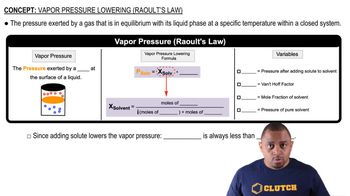
Vapor Pressure

Vapor pressure is the pressure exerted by a vapor in equilibrium with its liquid or solid phase at a given temperature. It reflects the tendency of particles to escape from the liquid phase into the vapor phase. As temperature increases, vapor pressure typically increases, indicating that more molecules have enough energy to enter the vapor phase.
Video consigliato:
Percorso guidato
02:40
Raoult's Law and Vapor Pressure

Heat of Vaporization

The heat of vaporization is the amount of energy required to convert a unit mass of a liquid into vapor without a change in temperature. This value is crucial for understanding phase changes and is typically expressed in joules per gram or calories per gram. It can be determined using the Clausius-Clapeyron equation, which relates vapor pressure and temperature.
Video consigliato:

Normal Boiling Point

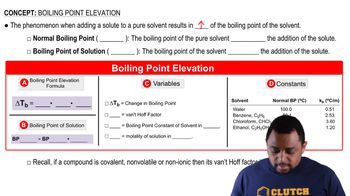
The normal boiling point of a substance is the temperature at which its vapor pressure equals the standard atmospheric pressure (1 atm or 760 torr). At this point, the liquid turns into vapor throughout the liquid, not just at the surface. For nitrogen, determining the normal boiling point involves analyzing the vapor pressure data to find the temperature at which the pressure reaches 760 torr.
Video consigliato:
Percorso guidato
03:05
Boiling Point Elevation