Ch.12 - Liquids, Solids & Intermolecular Forces
Tro - Chemistry: A Molecular Approach 5th Edition
Tro5th EditionChemistry: A Molecular ApproachISBN: 9780134874371Non è quello che usi tu?Cambia libro di testo
Capitolo 12, Problema 54

Which evaporates more quickly: 55 mL of water (H2O) in a beaker or 100 mL of acetone [(CH3)2CO] in an identical beaker under identical conditions? Is the vapor pressure of the two substances different? Explain.

Guida verificata passo dopo passo
1
Identify the key factors that affect evaporation: surface area, temperature, and vapor pressure. Since the beakers are identical and conditions are the same, focus on vapor pressure.
Understand that vapor pressure is the pressure exerted by a vapor in equilibrium with its liquid phase at a given temperature.
Research the vapor pressures of water and acetone at room temperature. Acetone generally has a higher vapor pressure than water.
Explain that a higher vapor pressure indicates that a substance evaporates more readily because more molecules have enough energy to escape the liquid phase.
Conclude that acetone, with its higher vapor pressure, will evaporate more quickly than water under identical conditions.

Risposta video verificata per un problema simile:

Questa soluzione video è stata consigliata dai nostri tutor come utile per risolvere questo problema.
Durata del video:
3m

Concetti chiave

Ecco i concetti essenziali che devi comprendere per rispondere correttamente alla domanda.

Vapor Pressure

Vapor pressure is the pressure exerted by a vapor in equilibrium with its liquid or solid phase at a given temperature. It indicates how readily a substance will evaporate; higher vapor pressure means a substance evaporates more quickly. Water and acetone have different vapor pressures due to their molecular structures and intermolecular forces, affecting their evaporation rates.
Video consigliato:
Percorso guidato
02:40
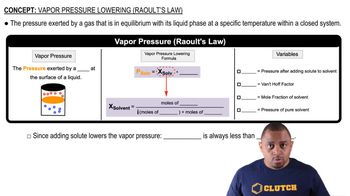
Raoult's Law and Vapor Pressure

Intermolecular Forces

Intermolecular forces are the forces of attraction or repulsion between molecules. They play a crucial role in determining the physical properties of substances, including boiling points and evaporation rates. Water has strong hydrogen bonding, while acetone has weaker dipole-dipole interactions, leading to acetone evaporating more quickly than water under identical conditions.
Video consigliato:
Percorso guidato
01:59
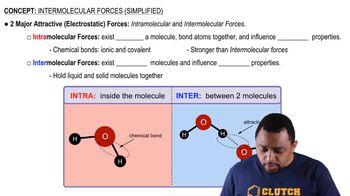
Intermolecular vs Intramolecular Forces

Evaporation Rate

The evaporation rate is the speed at which molecules transition from the liquid phase to the vapor phase. Factors influencing evaporation include temperature, surface area, and intermolecular forces. In this scenario, acetone, with its lower boiling point and weaker intermolecular forces, will evaporate more quickly than water, despite the volume differences.
Video consigliato:
Percorso guidato
04:50
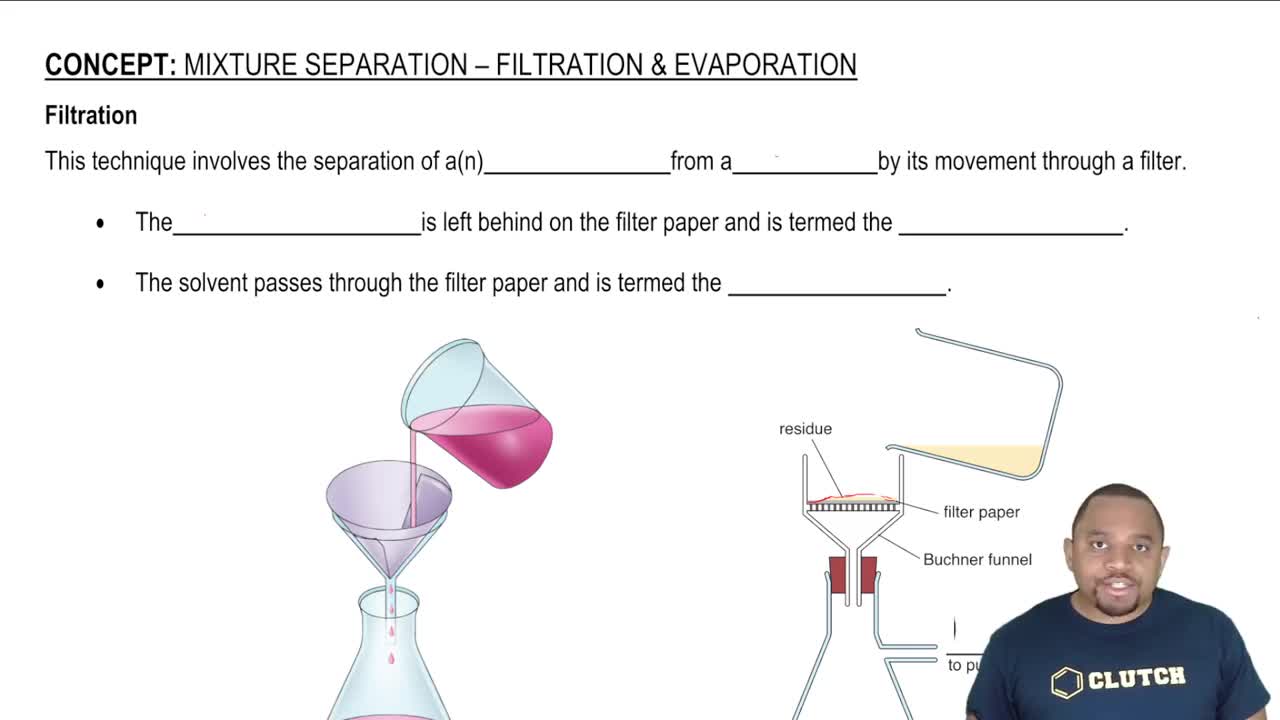
Filtration and Evaporation