Ch.13 - Solids & Modern Materials
Tro - Chemistry: A Molecular Approach 5th Edition
Tro5th EditionChemistry: A Molecular ApproachISBN: 9780134874371Non è quello che usi tu?Cambia libro di testo
Capitolo 13, Problema 29c

Determine the number of atoms per unit cell for each metal.
(c) Nickel

Guida verificata passo dopo passo
1
Determine the crystal structure of nickel. Nickel typically crystallizes in a face-centered cubic (FCC) structure.
In an FCC unit cell, atoms are located at each of the eight corners and at the center of each of the six faces.
Calculate the contribution of corner atoms to the unit cell. Each corner atom is shared by eight adjacent unit cells, so each corner atom contributes 1/8 of an atom to the unit cell.
Calculate the contribution of face-centered atoms to the unit cell. Each face-centered atom is shared by two adjacent unit cells, so each face-centered atom contributes 1/2 of an atom to the unit cell.
Add the contributions from corner and face-centered atoms to find the total number of atoms per unit cell in an FCC structure.

Risposta video verificata per un problema simile:

Questa soluzione video è stata consigliata dai nostri tutor come utile per risolvere questo problema.
Durata del video:
3m

Concetti chiave

Ecco i concetti essenziali che devi comprendere per rispondere correttamente alla domanda.

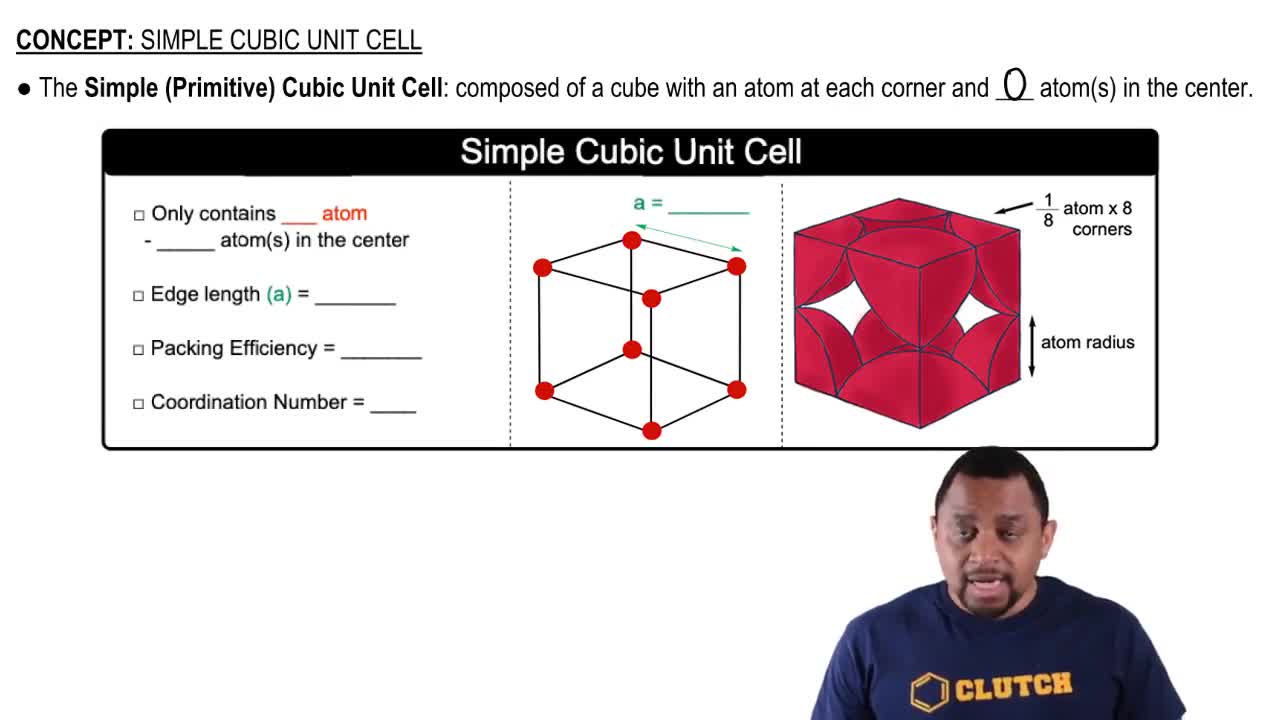
Unit Cell

A unit cell is the smallest repeating unit in a crystal lattice that reflects the symmetry and structure of the entire crystal. It defines the arrangement of atoms in a solid and is characterized by its dimensions and angles. Understanding the unit cell is crucial for determining the number of atoms it contains, which is essential for calculating properties like density.
Video consigliato:
Percorso guidato
01:27
Simple Cubic Unit Cell

Atomic Packing Factor (APF)

The Atomic Packing Factor (APF) is a measure of how efficiently atoms are packed in a unit cell. It is calculated as the volume occupied by the atoms in the unit cell divided by the total volume of the unit cell. Different metals have different APFs based on their crystal structures, which influences their physical properties and the number of atoms per unit cell.
Video consigliato:
Percorso guidato
01:56
Conversion Factors

Crystal Structure

Crystal structure refers to the ordered arrangement of atoms in a crystalline material. Common types include face-centered cubic (FCC), body-centered cubic (BCC), and hexagonal close-packed (HCP). Each structure has a specific number of atoms per unit cell, which is critical for understanding the material's properties, such as strength and conductivity, particularly for metals like nickel.
Video consigliato:
Percorso guidato
01:42
Resonance Structures