Ch.13 - Solids & Modern Materials
Tro - Chemistry: A Molecular Approach 5th Edition
Tro5th EditionChemistry: A Molecular ApproachISBN: 9780134874371Non è quello che usi tu?Cambia libro di testo
Capitolo 13, Problema 43d

Which solid in each pair has the higher melting point and why? d. NaCl(s) or CaO(s)

Guida verificata passo dopo passo
1
Identify the type of bonding in each compound: NaCl is an ionic compound formed by the transfer of electrons between Na and Cl, while CaO is also an ionic compound formed by the transfer of electrons between Ca and O.
Consider the charges on the ions: In NaCl, Na has a +1 charge and Cl has a -1 charge. In CaO, Ca has a +2 charge and O has a -2 charge.
Apply Coulomb's Law: The strength of the ionic bond is proportional to the product of the charges on the ions and inversely proportional to the distance between them.
Compare the ionic bond strength: Since CaO has ions with higher charges (+2 and -2) compared to NaCl (+1 and -1), the ionic bonds in CaO are stronger.
Conclude based on bond strength: Stronger ionic bonds in CaO result in a higher melting point compared to NaCl.

Risposta video verificata per un problema simile:

Questa soluzione video è stata consigliata dai nostri tutor come utile per risolvere questo problema.
Durata del video:
2m

Concetti chiave

Ecco i concetti essenziali che devi comprendere per rispondere correttamente alla domanda.

Ionic Bonding

Ionic bonding occurs when atoms transfer electrons, resulting in the formation of charged ions. These oppositely charged ions attract each other, creating a strong electrostatic force that holds them together in a solid lattice structure. The strength of these ionic bonds significantly influences the melting point of ionic compounds.
Video consigliato:

Lattice Energy

Lattice energy is the energy released when gaseous ions combine to form an ionic solid. It is a measure of the strength of the forces between the ions in the lattice. A higher lattice energy indicates stronger ionic bonds, which typically results in a higher melting point for the solid.
Video consigliato:

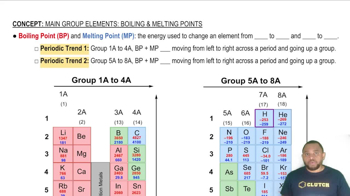
Comparative Melting Points

The melting point of a solid is the temperature at which it transitions from a solid to a liquid. In ionic compounds, the melting point can be compared based on the charges of the ions and their sizes. Generally, compounds with higher charges and smaller ionic radii have higher melting points due to stronger ionic interactions.
Video consigliato:
Percorso guidato
04:29
Boiling Point and Melting Point