Lead is a toxic metal that affects the central nervous system. A Pb-contaminated water sample contains 0.0011% Pb by mass. How much of the water (in mL) contains 150 mg of Pb? (Assume a density of 1.0 g/mL.)
Ch.14 - Solutions
Tro5th EditionChemistry: A Molecular ApproachISBN: 9780134874371Non è quello che usi tu?Cambia libro di testo
Capitolo 14, Problema 56
A dioxin-contaminated water source contains 0.085% dioxin by mass. How much dioxin is present in 2.5 L of this water? Assume a density of 1.00 g/mL.
Guida verificata passo dopo passo1
Convert the volume of water from liters to milliliters using the conversion factor: 1 L = 1000 mL.
Calculate the mass of the water using the density formula: \( \text{mass} = \text{density} \times \text{volume} \).
Determine the mass of dioxin in the water by using the percentage by mass: \( \text{mass of dioxin} = \text{mass of water} \times \frac{0.085}{100} \).
Ensure all units are consistent and check calculations for accuracy.
Summarize the steps and ensure understanding of the concept of percentage by mass and its application in this context.

Risposta video verificata per un problema simile:
Questa soluzione video è stata consigliata dai nostri tutor come utile per risolvere questo problema.
Durata del video:
2mConcetti chiave
Ecco i concetti essenziali che devi comprendere per rispondere correttamente alla domanda.
Concentration by Mass
Concentration by mass refers to the amount of solute (in this case, dioxin) present in a given mass of solution. It is often expressed as a percentage, indicating how many grams of solute are present in 100 grams of solution. Understanding this concept is crucial for calculating the mass of dioxin in a specific volume of contaminated water.
Video consigliato:
Percorso guidato
Atomic Mass
Density
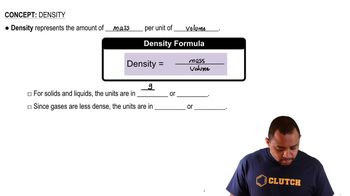
Density is defined as mass per unit volume and is a key property of substances. In this scenario, the density of the water is given as 1.00 g/mL, which means that 1 mL of water has a mass of 1 gram. This information allows us to convert the volume of water (2.5 L) into mass, which is necessary for calculating the total mass of dioxin present.
Video consigliato:
Percorso guidato
Density Concepts
Volume to Mass Conversion
To find the mass of a substance from its volume, we use the formula: mass = volume × density. In this case, converting 2.5 L of water to grams using the provided density allows us to determine the total mass of the water, which is essential for applying the concentration percentage to find the mass of dioxin present in the water.
Video consigliato:
Percorso guidato
Energy to Mass Conversion
Pratica correlata
Domanda del libro di testo
1971
views
Domanda del libro di testo
An aqueous KNO3 solution is made using 72.5 g of KNO3 diluted to a total solution volume of 2.00 L. Calculate the mass percent of the solution. (Assume a density of 1.05 g/mL for the solution.)
365
views
Domanda del libro di testo
Silver nitrate solutions are often used to plate silver onto other metals. What is the maximum amount of silver (in grams) that can be plated out of 4.8 L of an AgNO3 solution containing 3.4% Ag by mass? Assume that the density of the solution is 1.01 g/mL.
1989
views
Domanda del libro di testo
To what volume should you dilute 50.0 mL of a 5.00 M KI solution so that 25.0 mL of the diluted solution contains 3.05 g of KI?
4459
views