Ch.14 - Solutions
Tro - Chemistry: A Molecular Approach 5th Edition
Tro5th EditionChemistry: A Molecular ApproachISBN: 9780134874371Non è quello che usi tu?Cambia libro di testo
Capitolo 14, Problema 42

A solution contains 32 g of KNO3 per 100.0 g of water at 25 °C. Is the solution unsaturated, saturated, or supersaturated? (Use Figure 13.11.)

Guida verificata passo dopo passo
1
Determine the solubility of KNO3 in water at 25 °C from Figure 13.11 or a similar solubility chart.
Calculate the mass of KNO3 that can be dissolved in 100.0 g of water at 25 °C using the solubility data.
Compare the actual mass of KNO3 in the solution (32 g) to the calculated mass from step 2.
If the actual mass is less than the calculated mass, the solution is unsaturated. If it is equal, the solution is saturated. If it is more, the solution is supersaturated.
Conclude whether the solution is unsaturated, saturated, or supersaturated based on the comparison.

Risposta video verificata per un problema simile:

Questa soluzione video è stata consigliata dai nostri tutor come utile per risolvere questo problema.
Durata del video:
1m

Concetti chiave

Ecco i concetti essenziali che devi comprendere per rispondere correttamente alla domanda.

Solubility

Solubility is the maximum amount of a solute that can dissolve in a given amount of solvent at a specific temperature. For KNO3 in water at 25 °C, solubility is a critical factor in determining whether a solution is unsaturated, saturated, or supersaturated. Understanding solubility helps predict how much solute can be dissolved before reaching a limit.
Video consigliato:
Percorso guidato
00:28
Solubility Rules

Saturated Solution

A saturated solution is one in which the maximum amount of solute has been dissolved in the solvent at a given temperature. At this point, any additional solute will not dissolve and will remain as a solid. Identifying whether a solution is saturated involves comparing the amount of solute present to the solubility limit at the specified temperature.
Video consigliato:
Percorso guidato
01:11
Types of Aqueous Solutions

Supersaturation

Supersaturation occurs when a solution contains more solute than it can theoretically hold at a given temperature, often achieved by heating the solution and then cooling it slowly. This state is unstable, and any disturbance can cause the excess solute to precipitate out. Recognizing supersaturation is essential for understanding the behavior of solutions under varying conditions.
Video consigliato:
Percorso guidato
01:49
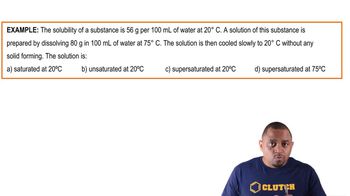
Types of Aqueous Solution Example