Ch.14 - Solutions
Tro - Chemistry: A Molecular Approach 5th Edition
Tro5th EditionChemistry: A Molecular ApproachISBN: 9780134874371Non è quello che usi tu?Cambia libro di testo
Capitolo 14, Problema 49

Calculate the mass of nitrogen dissolved at room temperature in an 80.0-L home aquarium, assuming a total pressure of 1.0 atm and a mole fraction for nitrogen of 0.78.

Guida verificata passo dopo passo
1
Identify the relevant law: Use Henry's Law, which states that the solubility of a gas in a liquid is directly proportional to the partial pressure of the gas above the liquid.
Calculate the partial pressure of nitrogen: Multiply the total pressure by the mole fraction of nitrogen, i.e., \( P_{\text{N}_2} = 1.0 \text{ atm} \times 0.78 \).
Use Henry's Law to find the concentration of nitrogen: \( C = k_H \times P_{\text{N}_2} \), where \( k_H \) is the Henry's Law constant for nitrogen at room temperature.
Determine the volume of water in the aquarium: Since the aquarium is 80.0 L, assume this is the volume of water available for dissolving nitrogen.
Calculate the mass of nitrogen: Use the concentration from Henry's Law and the volume of water to find the moles of nitrogen, then convert moles to mass using the molar mass of nitrogen (28.02 g/mol).

Concetti chiave

Ecco i concetti essenziali che devi comprendere per rispondere correttamente alla domanda.

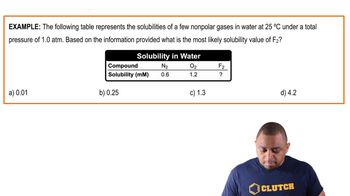
Gas Solubility

Gas solubility refers to the amount of gas that can dissolve in a liquid at a given temperature and pressure. This is influenced by factors such as the nature of the gas, the solvent, and the temperature. For gases, solubility often increases with pressure, following Henry's Law, which states that the amount of gas dissolved is proportional to its partial pressure above the liquid.
Video consigliato:
Percorso guidato
01:44
Gas Solubility Example

Mole Fraction

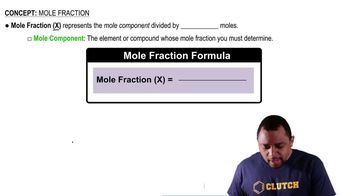
Mole fraction is a way of expressing the concentration of a component in a mixture. It is defined as the ratio of the number of moles of a specific component to the total number of moles of all components in the mixture. In this context, the mole fraction of nitrogen indicates its proportion in the gas phase, which helps in calculating the partial pressure and subsequently the amount of nitrogen that can dissolve in the aquarium water.
Video consigliato:
Percorso guidato
00:36
Mole Fraction Formula

Ideal Gas Law

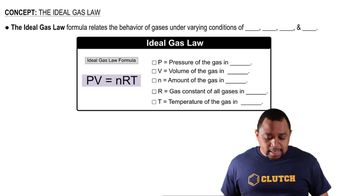
The Ideal Gas Law is a fundamental equation in chemistry that relates the pressure, volume, temperature, and number of moles of an ideal gas. It is expressed as PV = nRT, where P is pressure, V is volume, n is the number of moles, R is the ideal gas constant, and T is temperature in Kelvin. This law is essential for calculating the number of moles of nitrogen in the aquarium based on the given pressure and volume, which can then be used to determine the mass of nitrogen dissolved.
Video consigliato:
Percorso guidato
01:15
Ideal Gas Law Formula