Ch.14 - Solutions
Tro - Chemistry: A Molecular Approach 5th Edition
Tro5th EditionChemistry: A Molecular ApproachISBN: 9780134874371Non è quello che usi tu?Cambia libro di testo
Capitolo 14, Problema 34

For each compound, would you expect greater solubility in water or in hexane? Indicate the kinds of intermolecular forces that would occur between the solute and the solvent in which the molecule is most soluble. d. ethylene glycol

Guida verificata passo dopo passo
1
Identify the molecular structure of ethylene glycol, which is HOCH2CH2OH. Note that it contains hydroxyl groups (-OH) which are polar.
Recognize that water is a polar solvent and hexane is a non-polar solvent. Polar solutes generally dissolve better in polar solvents due to similar types of intermolecular forces.
Analyze the intermolecular forces in ethylene glycol. The presence of -OH groups allows it to form hydrogen bonds, which are strong intermolecular forces.
Predict the solubility of ethylene glycol in water by considering its ability to form hydrogen bonds with water molecules, which also contain polar O-H bonds.
Conclude that ethylene glycol would have greater solubility in water due to the hydrogen bonding between the -OH groups of ethylene glycol and the water molecules, compared to weaker dispersion forces that would be present in hexane.

Risposta video verificata per un problema simile:

Questa soluzione video è stata consigliata dai nostri tutor come utile per risolvere questo problema.
Durata del video:
2m

Concetti chiave

Ecco i concetti essenziali che devi comprendere per rispondere correttamente alla domanda.

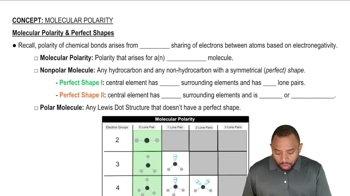
Polarity of Molecules

Polarity refers to the distribution of electrical charge over the atoms in a molecule. Polar molecules, which have a significant difference in electronegativity between their atoms, tend to dissolve well in polar solvents like water. In contrast, nonpolar molecules, which have an even distribution of charge, are more soluble in nonpolar solvents like hexane.
Video consigliato:
Percorso guidato
02:38
Molecular Polarity

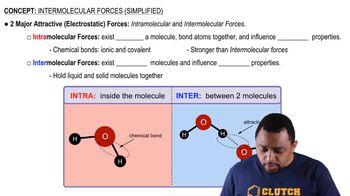
Intermolecular Forces

Intermolecular forces are the forces of attraction or repulsion between neighboring particles (atoms, molecules, or ions). The main types include hydrogen bonding, dipole-dipole interactions, and London dispersion forces. The strength and type of these forces influence a compound's solubility in a given solvent, as similar types of intermolecular forces between solute and solvent enhance solubility.
Video consigliato:
Percorso guidato
01:59
Intermolecular vs Intramolecular Forces

Hydrogen Bonding

Hydrogen bonding is a strong type of dipole-dipole interaction that occurs when hydrogen is bonded to highly electronegative atoms like oxygen, nitrogen, or fluorine. Ethylene glycol, which contains hydroxyl (-OH) groups, can form hydrogen bonds with water, significantly increasing its solubility in polar solvents. This interaction is crucial for understanding why certain compounds dissolve better in water than in nonpolar solvents.
Video consigliato:
Percorso guidato
01:22
Hydrogenation Reactions