Consider the gas-phase reaction: H2(g) + I2(g) → 2 HI(g) The reaction was experimentally determined to be first order in H2 and first order in I2. Consider the proposed mechanisms. Proposed mechanism I: H2(g) + I2(g) → 2 HI(g) Single step Proposed mechanism II: I2(g) Δk1k-12 I(g) Fast H2( g) + 2 I( g) → k22 HI( g) Slow b. What kind of experimental evidence might lead you to favor mechanism II over mechanism I?
Ch.15 - Chemical Kinetics
Tro5th EditionChemistry: A Molecular ApproachISBN: 9780134874371Non è quello che usi tu?Cambia libro di testo
Capitolo 15, Problema 108
What rate law corresponds to the proposed mechanism for the formation of hydrogen iodide, which can be written in simplified form as: I2 Δk1k-1 2I (Fast), I + H2 Δk2k-2 H2I (Fast), H2I + I ¡k3 2HI (Slow)?
Guida verificata passo dopo passo1
Identify the slow step in the mechanism, as it determines the rate law. In this case, the slow step is: \( \text{H}_2\text{I} + \text{I} \xrightarrow{k_3} 2\text{HI} \).
Write the rate law based on the slow step. The rate of the reaction is determined by the concentration of the reactants in the slow step: \( \text{Rate} = k_3 [\text{H}_2\text{I}][\text{I}] \).
Express the intermediate \( \text{H}_2\text{I} \) in terms of the initial reactants using the fast equilibrium steps. From the second fast step: \( \text{I} + \text{H}_2 \rightleftharpoons \text{H}_2\text{I} \), we have \( K_2 = \frac{[\text{H}_2\text{I}]}{[\text{I}][\text{H}_2]} \).
Solve for \( [\text{H}_2\text{I}] \) in terms of \( [\text{I}] \) and \( [\text{H}_2] \) using the equilibrium constant \( K_2 \): \( [\text{H}_2\text{I}] = K_2 [\text{I}][\text{H}_2] \).
Substitute \( [\text{H}_2\text{I}] \) from the previous step into the rate law: \( \text{Rate} = k_3 K_2 [\text{I}]^2 [\text{H}_2] \). This is the rate law for the overall reaction.
Concetti chiave
Ecco i concetti essenziali che devi comprendere per rispondere correttamente alla domanda.
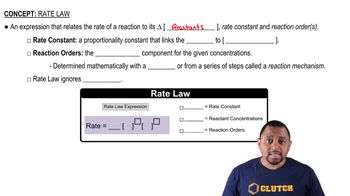
Rate Law
A rate law expresses the relationship between the rate of a chemical reaction and the concentration of its reactants. It is typically formulated as rate = k[A]^m[B]^n, where k is the rate constant, and m and n are the orders of the reaction with respect to reactants A and B. Understanding how to derive the rate law from a proposed reaction mechanism is crucial for predicting how changes in concentration affect the reaction rate.
Video consigliato:
Percorso guidato
Rate Law Fundamentals
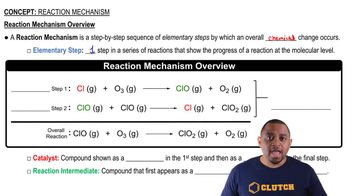
Reaction Mechanism
A reaction mechanism is a step-by-step description of the pathway taken during a chemical reaction, detailing each elementary step involved. Each step can have different rates, and the slowest step, known as the rate-determining step, dictates the overall reaction rate. Analyzing the proposed mechanism helps in identifying which steps contribute to the rate law and how intermediates are involved.
Video consigliato:
Percorso guidato
Reaction Mechanism Overview
Elementary Steps and Rate-Determining Step
Elementary steps are individual reactions that occur in a mechanism, each with its own rate constant. The rate-determining step is the slowest step in the mechanism, which limits the overall rate of the reaction. In the given mechanism, identifying the slow step allows us to derive the rate law by focusing on the concentrations of the reactants involved in that step, while considering the fast steps as equilibria.
Video consigliato:
Percorso guidato
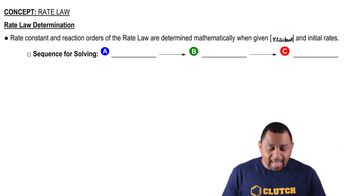
Rate Law Determination
Pratica correlata
Domanda del libro di testo
1632
views
Domanda del libro di testo
The half-life for radioactive decay (a first-order process) of plutonium- 239 is 24,000 years. How many years does it take for one mole of this radioactive material to decay until just one atom remains?
1399
views
Domanda del libro di testo
A certain substance X decomposes. Fifty percent of X remains after 100 minutes. How much X remains after 200 minutes if the reaction order with respect to X is (c) second order?
1403
views
Domanda del libro di testo
Phosgene (Cl2CO), a poison gas used in World War I, is formed
by the reaction of Cl2 and CO. The proposed mechanism for the
reaction is:
Cl2Δ2 Cl (fast, equilibrium)
Cl + COΔClCO (fast, equilibrium)
ClCO + Cl2¡Cl2CO + Cl (slow)
