Ch.15 - Chemical Kinetics
Tro - Chemistry: A Molecular Approach 5th Edition
Tro5th EditionChemistry: A Molecular ApproachISBN: 9780134874371Non è quello che usi tu?Cambia libro di testo
Capitolo 15, Problema 77a

Consider this three-step mechanism for a reaction:
Cl2 (g) k1⇌k2 2 Cl (g) Fast
Cl (g) + CHCl3 (g) →k3 HCl (g) + CCl3 (g) Slow
Cl (g) + CCl3 (g) →k4 CCl4 (g) Fast
a. What is the overall reaction?

Guida verificata passo dopo passo
1
Identify the reactants and products in each step of the mechanism. For the first step, the reactants are Cl2 and the products are 2 Cl. In the second step, the reactants are Cl and CHCl3, and the products are HCl and CCl3. In the third step, the reactants are Cl and CCl3, and the product is CCl4.
Determine the intermediates by identifying species that appear as products in one step and reactants in another. Here, Cl and CCl3 are intermediates as they are produced in one step and consumed in another.
Cancel out the intermediates from the overall reaction. Since Cl and CCl3 are intermediates, they should not appear in the final balanced equation.
Write the overall reaction by combining the remaining reactants and products, ensuring to balance the equation. Start with the initial reactants that are not intermediates and include the final products that are not intermediates.
Check the stoichiometry of the final equation to ensure that the number of atoms of each element is the same on both sides of the equation.

Risposta video verificata per un problema simile:

Questa soluzione video è stata consigliata dai nostri tutor come utile per risolvere questo problema.
Durata del video:
2m

Concetti chiave

Ecco i concetti essenziali che devi comprendere per rispondere correttamente alla domanda.

Reaction Mechanism

A reaction mechanism is a step-by-step description of how a chemical reaction occurs at the molecular level. It outlines the individual elementary steps that lead to the overall reaction, including the formation and consumption of intermediates. Understanding the mechanism helps in predicting the rate and outcome of the reaction.
Video consigliato:
Percorso guidato
03:06
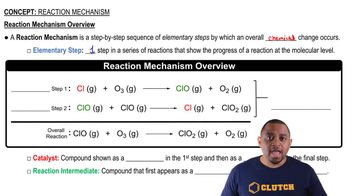
Reaction Mechanism Overview

Elementary Steps

Elementary steps are the individual reactions that make up a reaction mechanism. Each step represents a single molecular event, such as the collision of reactants or the formation of products. The rate of the overall reaction is often determined by the slowest elementary step, known as the rate-determining step.
Video consigliato:
Percorso guidato
03:06
Reaction Mechanism Overview

Overall Reaction

The overall reaction is the net equation that summarizes the reactants and products of a chemical process, derived from the individual elementary steps. It reflects the stoichiometry of the reaction and provides insight into the conservation of mass. To find the overall reaction, one must combine the elementary steps while canceling out any intermediates.
Video consigliato:
Percorso guidato
07:02
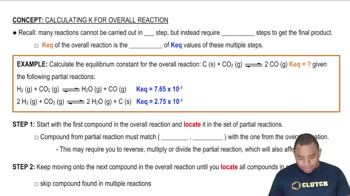
Overall Reaction Equilibrium Constant