Ch.15 - Chemical Kinetics
Tro - Chemistry: A Molecular Approach 5th Edition
Tro5th EditionChemistry: A Molecular ApproachISBN: 9780134874371Non è quello che usi tu?Cambia libro di testo
Capitolo 15, Problema 59

The diagram shows the energy of a reaction as the reaction progresses. Label each blank box in the diagram.
a. reactants b. products c. activation energy (Ea) d. enthalpy of reaction (ΔHrxn)

Guida verificata passo dopo passo
1
Identify the starting point of the reaction on the energy diagram, which represents the energy level of the reactants. Label this point as 'reactants'.
Locate the ending point of the reaction on the energy diagram, which represents the energy level of the products. Label this point as 'products'.
Find the peak of the energy curve, which represents the highest energy point during the reaction. The difference in energy between this peak and the reactants is the activation energy (E_a). Label this difference as 'activation energy (E_a)'.
Determine the difference in energy between the reactants and the products. This difference is the enthalpy of reaction (ΔH_rxn). Label this difference as 'enthalpy of reaction (ΔH_rxn)'.
Ensure that each label corresponds to the correct part of the energy diagram, reflecting the energy changes throughout the reaction process.

Risposta video verificata per un problema simile:

Questa soluzione video è stata consigliata dai nostri tutor come utile per risolvere questo problema.
Durata del video:
3m

Concetti chiave

Ecco i concetti essenziali che devi comprendere per rispondere correttamente alla domanda.

Reactants and Products

In a chemical reaction, reactants are the starting substances that undergo a transformation, while products are the substances formed as a result of the reaction. Understanding the difference between these two is crucial for analyzing reaction diagrams, as they represent the initial and final states of the reaction.
Video consigliato:
Percorso guidato
00:53
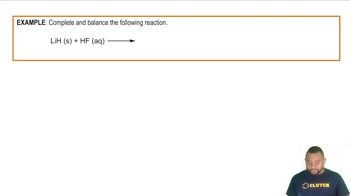
Production of Hydrogen Example

Activation Energy (Eₐ)

Activation energy is the minimum energy required for a chemical reaction to occur. It represents the energy barrier that must be overcome for reactants to be converted into products. This concept is essential for understanding the energy profile of a reaction, as it indicates how much energy is needed to initiate the process.
Video consigliato:
Percorso guidato
02:02
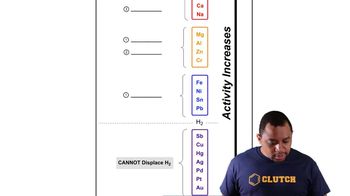
Activity Series Chart

Enthalpy of Reaction (ΔH₍rxn₎)

The enthalpy of reaction, denoted as ΔH₍rxn₎, is the change in heat content during a chemical reaction at constant pressure. It indicates whether a reaction is exothermic (releases heat) or endothermic (absorbs heat). This concept is vital for interpreting the energy changes depicted in reaction diagrams, as it helps to determine the overall energy shift from reactants to products.
Video consigliato:
Percorso guidato
02:34
Enthalpy of Formation
Pratica correlata
Domanda del libro di testo

The half-life for the radioactive decay of C-14 is 5730 years and is independent of the initial concentration. How long does it take for 25% of the C-14 atoms in a sample of C-14 to decay?

1360
views
Domanda del libro di testo

The data shown here were collected for the first-order reaction: N2O(g) → N2(g) + O(g) Use an Arrhenius plot to determine the activation barrier and frequency factor for the reaction.

Temperature (K) Rate Constant (1 , s)

800 3.24⨉10- 5

900 0.00214

1000 0.0614

1100 0.955

1575
views
Domanda del libro di testo

The half-life for the radioactive decay of C-14 is 5730 years and is independent of the initial concentration. If a sample of C-14 initially contains 1.5 mmol of C-14, how many millimoles are left after 2255 years?

1764
views
Domanda del libro di testo

The activation energy of a reaction is 56.8 kJ/mol and the frequency factor is 1.5⨉1011/ s. Calculate the rate constant of the reaction at 25 °C.

2935
views
1
comments
Domanda del libro di testo

The half-life for the radioactive decay of U-238 is 4.5 billion years and is independent of initial concentration. If a sample of U-238 initially contained 1.5⨉1018 atoms when the universe was formed 13.8 billion years ago, how many U-238 atoms does it contain today?

663
views
1
rank
Domanda del libro di testo

The rate constant (k) for a reaction was measured as a function of temperature. A plot of ln k versus 1/T (in K) is linear and has a slope of -7445 K. Calculate the activation energy for the reaction.

6617
views
1
rank