Ch.15 - Chemical Kinetics
Tro - Chemistry: A Molecular Approach 5th Edition
Tro5th EditionChemistry: A Molecular ApproachISBN: 9780134874371Non è quello che usi tu?Cambia libro di testo
Capitolo 15, Problema 35a

This graph shows a plot of the rate of a reaction versus the concentration of the reactant A for the reaction A → products. a. What is the order of the reaction with respect to A?

Guida verificata passo dopo passo
1
Identify the shape of the graph. If the graph is a straight line passing through the origin, the reaction order can be determined directly from the slope.
Recall the general rate law expression for a reaction involving a single reactant A: Rate = k[A]^n, where k is the rate constant, [A] is the concentration of reactant A, and n is the order of the reaction with respect to A.
Determine if the graph represents a direct proportionality between the rate and the concentration of A. If the rate is directly proportional to [A], then the reaction is first order with respect to A.
If the graph shows that the rate is proportional to the square of the concentration of A ([A]^2), then the reaction is second order with respect to A.
If the graph is more complex, or if it shows a different dependency, consider other reaction orders or the possibility of mixed-order kinetics.

Risposta video verificata per un problema simile:

Questa soluzione video è stata consigliata dai nostri tutor come utile per risolvere questo problema.
Durata del video:
57s

Concetti chiave

Ecco i concetti essenziali che devi comprendere per rispondere correttamente alla domanda.

Reaction Order

The order of a reaction refers to the power to which the concentration of a reactant is raised in the rate law. It indicates how the rate of reaction is affected by changes in the concentration of that reactant. For example, if the rate of reaction doubles when the concentration of reactant A is doubled, the reaction is first order with respect to A.
Video consigliato:
Percorso guidato
00:36
Average Bond Order

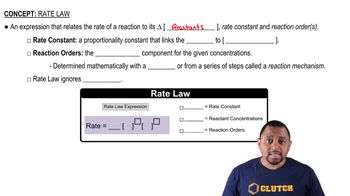
Rate Law

The rate law is an equation that relates the rate of a reaction to the concentration of its reactants, typically expressed as rate = k[A]^n, where k is the rate constant, [A] is the concentration of reactant A, and n is the order of the reaction. The rate law can be determined experimentally and provides insight into the mechanism of the reaction.
Video consigliato:
Percorso guidato
01:52
Rate Law Fundamentals

Graphical Analysis of Reaction Rates

Graphical analysis involves plotting the rate of reaction against the concentration of reactants to determine the relationship between them. For a first-order reaction, a plot of rate versus concentration will yield a straight line, indicating a linear relationship. This visual representation helps in identifying the order of the reaction based on the shape of the graph.
Video consigliato:
Percorso guidato
02:03
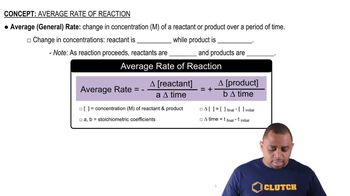
Average Rate of Reaction