
The reaction A¡products was monitored as a function of time. The results are shown here. Time (s) [A] (M) 0 1.000 25 0.914 50 0.829 75 0.744 100 0.659 125 0.573 150 0.488 175 0.403 200 0.318 Determine the order of the reaction and the value of the rate constant. What is the rate of reaction when [A] = 0.10 M?
Ch.15 - Chemical Kinetics
Tro5th EditionChemistry: A Molecular ApproachISBN: 9780134874371Non è quello che usi tu?Cambia libro di testo
Capitolo 15, Problema 53a
This reaction was monitored as a function of time: A → B + C A plot of ln[A] versus time yields a straight line with slope -0.0045/s. a. What is the value of the rate constant (k) for this reaction at this temperature?
Guida verificata passo dopo passo1
Recognize that the plot of \( \ln[A] \) versus time yielding a straight line indicates a first-order reaction.
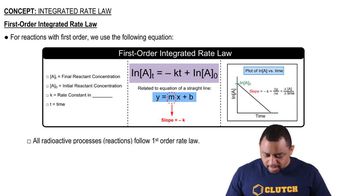
For a first-order reaction, the rate law is given by \( \ln[A] = -kt + \ln[A]_0 \), where \( k \) is the rate constant.
The slope of the line in a plot of \( \ln[A] \) versus time for a first-order reaction is equal to \(-k\).
Given that the slope of the line is \(-0.0045/s\), equate this to \(-k\) to find \( k \).
Conclude that the rate constant \( k \) is 0.0045/s, as the negative sign indicates the direction of the slope.

Risposta video verificata per un problema simile:
Questa soluzione video è stata consigliata dai nostri tutor come utile per risolvere questo problema.
Durata del video:
2mConcetti chiave
Ecco i concetti essenziali che devi comprendere per rispondere correttamente alla domanda.
First-Order Reactions
First-order reactions are characterized by a rate that is directly proportional to the concentration of one reactant. The integrated rate law for a first-order reaction can be expressed as ln[A] = -kt + ln[A]₀, where k is the rate constant, [A]₀ is the initial concentration, and [A] is the concentration at time t. The linear relationship between ln[A] and time indicates that the reaction follows first-order kinetics.
Video consigliato:
Percorso guidato
First-Order Reactions
Rate Constant (k)
The rate constant (k) is a proportionality factor in the rate law that quantifies the speed of a chemical reaction. For first-order reactions, the rate constant has units of time⁻¹, such as s⁻¹. The value of k can be determined from the slope of the ln[A] versus time plot, where the slope is equal to -k. In this case, the slope of -0.0045/s indicates that k = 0.0045 s⁻¹.
Video consigliato:
Percorso guidato
Equilibrium Constant K
Graphical Analysis of Reaction Kinetics
Graphical analysis is a powerful tool in chemical kinetics, allowing for the determination of reaction order and rate constants. By plotting ln[A] against time for a first-order reaction, a straight line is obtained, confirming the reaction's order. The slope of this line provides the rate constant, facilitating the understanding of how concentration changes over time. This method is essential for analyzing experimental data in kinetics.
Video consigliato:
Percorso guidato
Dimensional Analysis
Pratica correlata
Domanda del libro di testo
835
views
Domanda del libro di testo
The tabulated data show the concentration of AB versus time for this reaction: AB( g)¡A( g) + B( g) Time (s) [AB] (M) 0 0.950 50 0.459 100 0.302 150 0.225 200 0.180 250 0.149 300 0.128 350 0.112 400 0.0994 450 0.0894 500 0.0812 Determine the order of the reaction and the value of the rate constant. Predict the concentration of AB at 25 s.
3257
views
4
comments
Domanda del libro di testo
This reaction was monitored as a function of time: AB → A + B A plot of 1/[AB] versus time yields a straight line with a slope of +0.55/Ms. b. Write the rate law for the reaction.
2203
views
