Ch.16 - Chemical Equilibrium
Tro - Chemistry: A Molecular Approach 5th Edition
Tro5th EditionChemistry: A Molecular ApproachISBN: 9780134874371Non è quello che usi tu?Cambia libro di testo
Capitolo 16, Problema 71e

Coal, which is primarily carbon, can be converted to natural gas, primarily CH4, by the exothermic reaction: C(s) + 2 H2(g) ⇌ CH4(g) Which disturbance will favor CH4 at equilibrium? e. adding a catalyst to the reaction mixture

Guida verificata passo dopo passo
1
Understand the role of a catalyst: A catalyst speeds up the rate of a reaction by lowering the activation energy. It does this without being consumed in the reaction.
Identify the reaction type: The given reaction C(s) + 2 H2(g) ⇌ CH4(g) is an equilibrium reaction, where reactants and products reach a state where their concentrations remain constant over time.
Recall Le Chatelier's Principle: This principle states that if a dynamic equilibrium is disturbed by changing the conditions, the position of equilibrium moves to counteract the change.
Analyze the effect of adding a catalyst: Adding a catalyst to an equilibrium reaction affects the rates of both the forward and reverse reactions equally. Therefore, it helps the system reach equilibrium faster but does not change the position of equilibrium.
Conclude the effect on CH4 production: Since adding a catalyst does not change the concentrations of reactants or products at equilibrium, it does not favor the production of CH4 specifically.

Risposta video verificata per un problema simile:

Questa soluzione video è stata consigliata dai nostri tutor come utile per risolvere questo problema.
Durata del video:
2m

Concetti chiave

Ecco i concetti essenziali che devi comprendere per rispondere correttamente alla domanda.

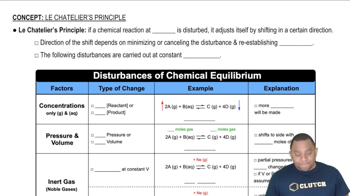
Le Chatelier's Principle

Le Chatelier's Principle states that if a dynamic equilibrium is disturbed by changing the conditions, the position of equilibrium shifts to counteract the change. This principle helps predict how a system at equilibrium will respond to changes in concentration, pressure, or temperature, ultimately favoring the formation of products or reactants.
Video consigliato:
Percorso guidato
07:32
Le Chatelier's Principle

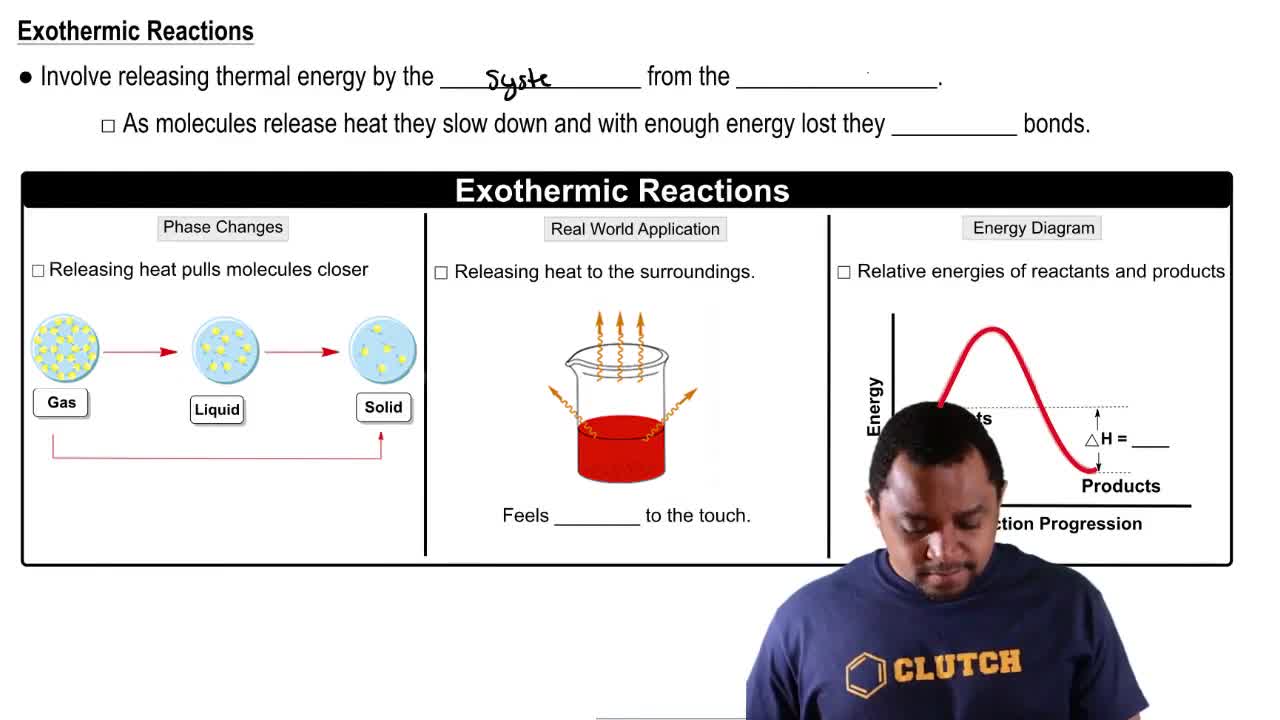
Exothermic Reactions

An exothermic reaction is a chemical reaction that releases energy in the form of heat. In the context of the given reaction, the conversion of carbon and hydrogen to methane (CH4) releases energy, which can influence the equilibrium position. Understanding whether a reaction is exothermic or endothermic is crucial for predicting how changes in temperature will affect the equilibrium.
Video consigliato:
Percorso guidato
02:38
Endothermic & Exothermic Reactions

Catalysts and Equilibrium

A catalyst is a substance that increases the rate of a chemical reaction without being consumed in the process. While catalysts do not affect the position of equilibrium, they help the system reach equilibrium faster. In the context of the question, adding a catalyst would not favor the formation of CH4 at equilibrium, as it does not shift the equilibrium position but merely accelerates the reaction rate.
Video consigliato:
Percorso guidato
02:35
Thermal Equilibrium
Pratica correlata
Domanda del libro di testo

Carbon monoxide replaces oxygen in oxygenated hemoglobin according to the reaction: HbO2(aq) + CO(aq) ⇌ HbCO(aq) + O2(aq) a. Use the reactions and associated equilibrium constants at body temperature given here to find the equilibrium constant for the reaction just shown. Hb(aq) + O2(aq) ⇌ HbO2(aq) Kc = 1.8 Hb(aq) + CO(aq) ⇌ HbCO(aq) Kc = 306

2555
views
Domanda del libro di testo

Coal, which is primarily carbon, can be converted to natural gas, primarily CH4, by the exothermic reaction: C(s) + 2 H2(g) ⇌ CH4(g) Which disturbance will favor CH4 at equilibrium?

a. adding more C to the reaction mixture b. adding more H2 to the reaction mixture d. lowering the volume of the reaction mixture f. adding neon gas to the reaction mixture

869
views
Domanda del libro di testo

This reaction is endothermic. C(s) + CO2(g) ⇌ 2 CO(g) Predict the effect (shift right, shift left, or no effect) of increasing and decreasing the reaction temperature. How does the value of the equilibrium constant depend on temperature?

2748
views
1
comments
Domanda del libro di testo

Coal, which is primarily carbon, can be converted to natural gas, primarily CH4, by the exothermic reaction: C(s) + 2 H2(g) ⇌ CH4(g) Which disturbance will favor CH4 at equilibrium? c. raising the temperature of the reaction mixture

1688
views
Domanda del libro di testo

Coal can be used to generate hydrogen gas (a potential fuel) by the endothermic reaction: C(s) + H2O(g) ⇌ CO(g) + H2(g) If this reaction mixture is at equilibrium, predict whether each disturbance will result in the formation of additional hydrogen gas, the formation of less hydrogen gas, or have no effect on the quantity of hydrogen gas. e. adding a catalyst to the reaction mixture

1292
views
1
rank