Ch.16 - Chemical Equilibrium
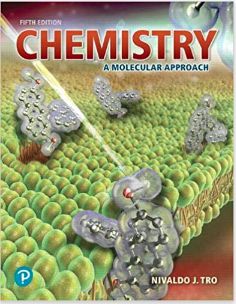
Tro - Chemistry: A Molecular Approach 5th Edition
Tro5th EditionChemistry: A Molecular ApproachISBN: 9780134874371Non è quello che usi tu?Cambia libro di testo
Capitolo 16, Problema 37

Consider the reaction: N2(g) + 3 H2(g) ⇌ 2 NH3(g) Complete the table. Assume that all concentrations are equilibrium concentrations in M.
T (K) [N2] [H2] [NH3] Kc
500 0.115 0.105 0.439 _
575 0.110 _ 0.128 9.6
775 0.120 0.140 _ 0.0584

Guida verificata passo dopo passo
1
Identify the balanced chemical equation for the reaction: \( N_2(g) + 3H_2(g) \rightleftharpoons 2NH_3(g) \).
Use the equilibrium constant expression for the reaction: \( K_c = \frac{[NH_3]^2}{[N_2][H_2]^3} \).
For the first row (T = 500 K), plug the given concentrations into the equilibrium expression to verify the provided \( K_c \) value.
For the second row (T = 575 K), use the given \([N_2]\), \([NH_3]\), and the calculated \( K_c \) from the first row to solve for the missing \([H_2]\) concentration.
For the third row (T = 775 K), use the given \([N_2]\), \([H_2]\), and the calculated \( K_c \) from the first row to solve for the missing \([NH_3]\) concentration.

Risposta video verificata per un problema simile:

Questa soluzione video è stata consigliata dai nostri tutor come utile per risolvere questo problema.
Durata del video:
1m

Concetti chiave

Ecco i concetti essenziali che devi comprendere per rispondere correttamente alla domanda.

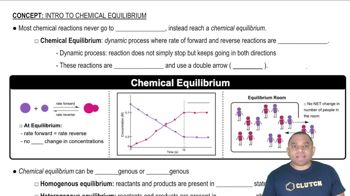
Chemical Equilibrium

Chemical equilibrium occurs when the rates of the forward and reverse reactions are equal, resulting in constant concentrations of reactants and products. In this state, the system is dynamic, meaning that reactions continue to occur, but there is no net change in concentration. Understanding this concept is crucial for analyzing equilibrium constants and predicting how changes in conditions affect the system.
Video consigliato:
Percorso guidato
04:21
Chemical Equilibrium Concepts

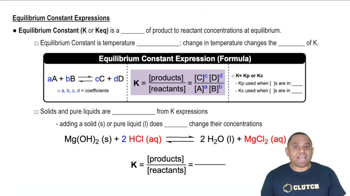
Equilibrium Constant (Kc)

The equilibrium constant (Kc) is a numerical value that expresses the ratio of the concentrations of products to reactants at equilibrium, each raised to the power of their coefficients in the balanced equation. It provides insight into the position of equilibrium; a larger Kc indicates a greater concentration of products, while a smaller Kc suggests more reactants. Calculating Kc is essential for completing the provided table.
Video consigliato:
Percorso guidato
03:20
Equilibrium Constant Expressions

Concentration Units (Molarity)

Molarity (M) is a unit of concentration defined as the number of moles of solute per liter of solution. It is commonly used in chemical equations and equilibrium expressions to quantify the amounts of reactants and products. Understanding how to convert between moles and molarity is vital for accurately filling in the missing values in the equilibrium concentration table.
Video consigliato: