Ch.16 - Chemical Equilibrium
Tro - Chemistry: A Molecular Approach 5th Edition
Tro5th EditionChemistry: A Molecular ApproachISBN: 9780134874371Non è quello che usi tu?Cambia libro di testo
Capitolo 16, Problema 27a

This reaction has an equilibrium constant of Kp = 2.26⨉104 at 298 K. CO(g) + 2 H2(g) ⇌ CH3OH(g) Calculate Kp for each reaction and predict whether reactants or products will be favored at equilibrium. a. CH3OH(g) ⇌ CO(g) + 2 H2(g)

Guida verificata passo dopo passo
1
1. The given reaction is CO(g) + 2 H2(g) ⇌ CH3OH(g) with Kp = 2.26⨉10^4. The reaction in part a is the reverse of the given reaction. In the reverse reaction, the equilibrium constant is the reciprocal of the original equilibrium constant. So, for the reaction CH3OH(g) ⇌ CO(g) + 2 H2(g), the equilibrium constant Kp' = 1/Kp.
2. To determine whether reactants or products will be favored at equilibrium, compare the value of Kp' to 1. If Kp' > 1, the products are favored. If Kp' < 1, the reactants are favored.
3. Since Kp' is the reciprocal of Kp, and Kp is greater than 1, Kp' will be less than 1.
4. Therefore, for the reaction CH3OH(g) ⇌ CO(g) + 2 H2(g), the reactants will be favored at equilibrium because Kp' < 1.
5. In summary, to solve problems like this, first determine the relationship between the given reaction and the reaction of interest. Then, use this relationship to find the equilibrium constant for the reaction of interest. Finally, compare the equilibrium constant to 1 to determine whether reactants or products are favored at equilibrium.

Risposta video verificata per un problema simile:

Questa soluzione video è stata consigliata dai nostri tutor come utile per risolvere questo problema.
Durata del video:
1m

Concetti chiave

Ecco i concetti essenziali che devi comprendere per rispondere correttamente alla domanda.

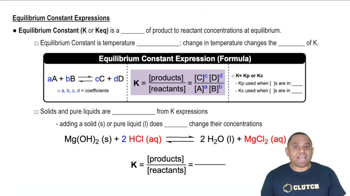
Equilibrium Constant (Kp)

The equilibrium constant (Kp) is a numerical value that expresses the ratio of the concentrations of products to reactants at equilibrium for a given reaction at a specific temperature. It is calculated using the partial pressures of gases involved in the reaction. A larger Kp value indicates that products are favored at equilibrium, while a smaller Kp suggests that reactants are favored.
Video consigliato:
Percorso guidato
03:20
Equilibrium Constant Expressions

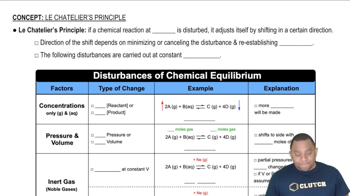
Le Chatelier's Principle

Le Chatelier's Principle states that if a dynamic equilibrium is disturbed by changing the conditions, the system will adjust itself to counteract the change and restore a new equilibrium. This principle helps predict how changes in concentration, pressure, or temperature will affect the position of equilibrium, guiding us in understanding whether reactants or products will be favored.
Video consigliato:
Percorso guidato
07:32
Le Chatelier's Principle

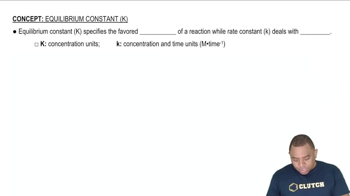
Reaction Direction and Equilibrium

The direction of a reaction at equilibrium can be determined by comparing the equilibrium constant (Kp) of the forward and reverse reactions. If Kp for the forward reaction is greater than 1, products are favored; if less than 1, reactants are favored. In this case, calculating Kp for the reverse reaction allows us to predict the favored side at equilibrium.
Video consigliato:
Percorso guidato
01:14
Equilibrium Constant K
Pratica correlata
Domanda del libro di testo

This reaction has an equilibrium constant of Kp = 2.2⨉106 at 298 K. 2 COF2(g) ⇌ CO2(g) + CF4(g) Calculate Kp for each reaction and predict whether reactants or products will be favored at equilibrium.

a. COF2 (g) ⇌ 1/2 CO2(g) + 1/2 CF4(g)

2676
views
1
comments
Domanda del libro di testo

This reaction has an equilibrium constant of Kp = 2.26⨉104 at 298 K. CO(g) + 2 H2(g) ⇌ CH3OH(g) Calculate Kp for each reaction and predict whether reactants or products will be favored at equilibrium.

c. 2 CH3OH(g) ⇌ 2 CO(g) + 4 H2(g)

726
views
Domanda del libro di testo

This reaction has an equilibrium constant of Kp = 2.26⨉104 at 298 K. CO(g) + 2 H2(g) ⇌ CH3OH(g) Calculate Kp for each reaction and predict whether reactants or products will be favored at equilibrium.

b. 1/2 CO(g) + H2 (g) ⇌ 1/2 CH3OH(g)

3230
views
Domanda del libro di testo

H2 and I2 are combined in a flask and allowed to react according to the reaction: H2(g) + I2(g) ⇌ 2 HI(g) Examine the figures (sequential in time) and answer the questions: a. Which figure represents the point at which equilibrium is reached?

824
views
Domanda del libro di testo

Ethene (C2H4) can be halogenated by this reaction: C2H4(g) + X2(g) ⇌ C2H4X2(g) where X2 can be Cl2 (green), Br2 (brown), or I2 (purple). Examine the three figures representing equilibrium concentrations in this reaction at the same temperature for the three different hal- ogens. Rank the equilibrium constants for the three reactions from largest to smallest.

1448
views
1
rank
Domanda del libro di testo

A chemist trying to synthesize a particular compound attempts two different synthesis reactions. The equilibrium constants for the two reactions are 23.3 and 2.2⨉104 at room temperature. However, upon carrying out both reactions for 15 minutes, the chemist finds that the reaction with the smaller equilibrium constant produces more of the desired product. Explain how this might be possible.

1175
views