Ch.17 - Acids and Bases
Tro - Chemistry: A Molecular Approach 5th Edition
Tro5th EditionChemistry: A Molecular ApproachISBN: 9780134874371Non è quello che usi tu?Cambia libro di testo
Capitolo 17, Problema 75

A 0.148 M solution of a monoprotic acid has a percent ionization of 1.55%. Determine the acid ionization constant (Ka) for the acid.

Guida verificata passo dopo passo
1
Identify the given information: the concentration of the acid \([HA]\) is 0.148 M, and the percent ionization is 1.55%.
Calculate the concentration of ionized acid \([H^+]\) using the percent ionization: \([H^+] = \frac{\text{percent ionization}}{100} \times [HA]\).
Since the acid is monoprotic, the concentration of \([A^-]\) is equal to \([H^+]\).
Write the expression for the acid ionization constant \(K_a\): \(K_a = \frac{[H^+][A^-]}{[HA] - [H^+]}\).
Substitute the values of \([H^+]\), \([A^-]\), and \([HA]\) into the \(K_a\) expression and simplify to find \(K_a\).

Risposta video verificata per un problema simile:

Questa soluzione video è stata consigliata dai nostri tutor come utile per risolvere questo problema.
Durata del video:
2m

Concetti chiave

Ecco i concetti essenziali che devi comprendere per rispondere correttamente alla domanda.

Monoprotic Acid

A monoprotic acid is an acid that can donate only one proton (H+) per molecule during the ionization process. This characteristic simplifies the calculation of its ionization constant, as the equilibrium expression involves only one dissociation step. Common examples include acetic acid and hydrochloric acid.
Video consigliato:

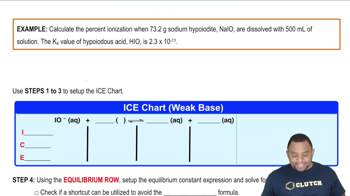
Percent Ionization

Percent ionization is a measure of the extent to which an acid dissociates in solution, expressed as a percentage of the initial concentration that has ionized. It is calculated using the formula: (concentration of ionized acid / initial concentration) × 100%. This concept helps in understanding the strength of the acid and its behavior in solution.
Video consigliato:
Percorso guidato
06:08
Percent Ionization Example

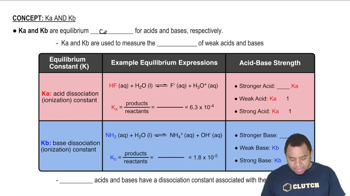
Acid Ionization Constant (Ka)

The acid ionization constant (Ka) quantifies the strength of an acid in solution, representing the equilibrium constant for the dissociation of the acid into its ions. It is calculated using the formula: Ka = [H+][A-] / [HA], where [H+] is the concentration of hydrogen ions, [A-] is the concentration of the conjugate base, and [HA] is the concentration of the undissociated acid. A higher Ka value indicates a stronger acid.
Video consigliato:
Percorso guidato
03:50
Characteristics of Ka and Kb