Ch.17 - Acids and Bases
Tro - Chemistry: A Molecular Approach 5th Edition
Tro5th EditionChemistry: A Molecular ApproachISBN: 9780134874371Non è quello che usi tu?Cambia libro di testo
Capitolo 17, Problema 111a

Calculate the [H3O+] and pH of each polyprotic acid solution. a. 0.350 M H3PO4

Guida verificata passo dopo passo
1
Recognize that H3PO4 (phosphoric acid) is a polyprotic acid, meaning it can donate more than one proton (H+). It dissociates in steps: H3PO4 -> H2PO4^- + H+, H2PO4^- -> HPO4^2- + H+, and HPO4^2- -> PO4^3- + H+.
The first dissociation of H3PO4 is the most significant in determining the [H3O+] and pH because it has the largest equilibrium constant (Ka1). Write the equilibrium expression for the first dissociation: Ka1 = [H2PO4^-][H3O+]/[H3PO4].
Assume that the initial concentration of H3PO4 is 0.350 M and that it dissociates to form x M of H3O+ and H2PO4^-. The equilibrium concentrations will be [H3PO4] = 0.350 - x, [H2PO4^-] = x, and [H3O+] = x.
Use the known value of Ka1 for H3PO4 (approximately 7.5 x 10^-3) to solve for x: Ka1 = x^2 / (0.350 - x). Since Ka1 is relatively small, you can assume x << 0.350 and simplify the equation to Ka1 ≈ x^2 / 0.350.
Once you have solved for x, which represents [H3O+], calculate the pH using the formula pH = -log[H3O+]. This will give you the pH of the solution.>

Risposta video verificata per un problema simile:

Questa soluzione video è stata consigliata dai nostri tutor come utile per risolvere questo problema.
Durata del video:
4m

Concetti chiave

Ecco i concetti essenziali che devi comprendere per rispondere correttamente alla domanda.

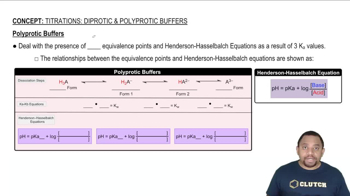
Polyprotic Acids

Polyprotic acids are acids that can donate more than one proton (H+) per molecule in a solution. Each dissociation step has its own equilibrium constant, known as Ka, which decreases with each successive proton donation. Understanding the behavior of polyprotic acids is crucial for calculating the concentrations of hydronium ions ([H3O+]) and the resulting pH in solutions.
Video consigliato:
Percorso guidato
03:25
Polyprotic Buffers

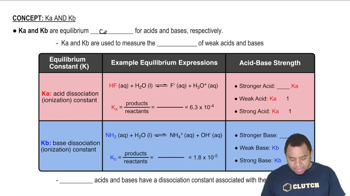
Dissociation Constants (Ka)

The dissociation constant (Ka) quantifies the strength of an acid in solution, indicating how well it donates protons. For polyprotic acids, there are multiple Ka values corresponding to each dissociation step. These constants are essential for determining the concentration of [H3O+] in a solution, as they help predict the extent of dissociation for each proton donation.
Video consigliato:
Percorso guidato
03:50
Characteristics of Ka and Kb

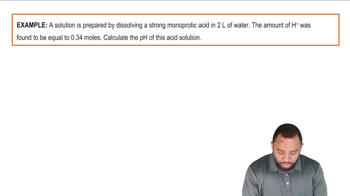
pH Calculation

pH is a measure of the acidity of a solution, defined as the negative logarithm of the hydronium ion concentration: pH = -log[H3O+]. To calculate pH for polyprotic acids, one must first determine the [H3O+] from the dissociation equilibria, considering the contributions from all dissociation steps. This calculation is vital for understanding the acid's strength and its effect on the solution's properties.
Video consigliato:
Percorso guidato
02:15
pH Calculation Example