Ch.17 - Acids and Bases
Tro - Chemistry: A Molecular Approach 5th Edition
Tro5th EditionChemistry: A Molecular ApproachISBN: 9780134874371Non è quello che usi tu?Cambia libro di testo
Capitolo 17, Problema 135

Common aspirin is acetylsalicylic acid, which has the structure shown here and a pKa of 3.5. Calculate the pH of a solution in which one normal adult dose of aspirin (6.5 * 10^2 mg) is dissolved in 8.0 ounces of water.

Guida verificata passo dopo passo
1
Convert the mass of aspirin from milligrams to grams by dividing by 1000.
Calculate the number of moles of aspirin using its molar mass (180.16 g/mol for acetylsalicylic acid).
Convert the volume of water from ounces to liters (1 ounce = 0.0295735 liters).
Determine the concentration of the aspirin solution in moles per liter (Molarity) by dividing the number of moles by the volume in liters.
Use the Henderson-Hasselbalch equation, \( \text{pH} = \text{pKa} + \log \left( \frac{[A^-]}{[HA]} \right) \), assuming that the concentration of the ionized form \([A^-]\) is equal to the concentration of the aspirin solution, to calculate the pH.

Concetti chiave

Ecco i concetti essenziali che devi comprendere per rispondere correttamente alla domanda.

pKa and pH Relationship

The pKa value of an acid indicates the pH at which half of the acid is dissociated into its conjugate base. For acetylsalicylic acid, with a pKa of 3.5, this means that at pH 3.5, the concentrations of the acid and its conjugate base are equal. Understanding this relationship is crucial for calculating the pH of a solution containing the acid.
Video consigliato:
Percorso guidato
02:09
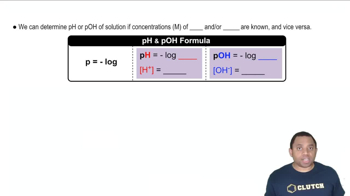
pH and pOH Calculations

Normality and Molarity

Normality (N) is a measure of concentration equivalent to molarity (M) but accounts for the reactive capacity of a solute. In the case of aspirin, knowing its molecular weight allows us to convert the mass of the dose into moles, which can then be used to determine the molarity of the solution. This is essential for calculating the resulting pH.
Video consigliato:

Dissociation of Weak Acids

Weak acids, like acetylsalicylic acid, do not fully dissociate in solution. Instead, they establish an equilibrium between the undissociated acid and its ions. The extent of this dissociation can be described using the acid dissociation constant (Ka), which is derived from the pKa. This concept is vital for determining the concentration of hydrogen ions in the solution, which directly affects the pH.
Video consigliato:
Percorso guidato
00:44
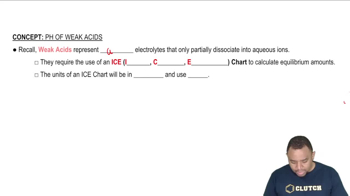
ICE Charts of Weak Acids