Ch.17 - Acids and Bases
Tro - Chemistry: A Molecular Approach 5th Edition
Tro5th EditionChemistry: A Molecular ApproachISBN: 9780134874371Non è quello che usi tu?Cambia libro di testo
Capitolo 17, Problema 33a,b,d

Identify each substance as an acid or a base and write a chemical equation showing how it is an acid or a base according to the Arrhenius definition. a. HNO3(aq) b. NH4+(aq) d. HC2H3O2(aq)

Guida verificata passo dopo passo
1
Identify the substance: HNO_3 is nitric acid.
Recall the Arrhenius definition: An acid is a substance that increases the concentration of H^+ ions in aqueous solution.
Write the dissociation equation for HNO_3 in water: HNO_3(aq) \(\rightarrow\) H^+(aq) + NO_3^-(aq).
Recognize that HNO_3 releases H^+ ions in solution, confirming it as an Arrhenius acid.
Conclude that HNO_3 is an acid according to the Arrhenius definition.

Risposta video verificata per un problema simile:

Questa soluzione video è stata consigliata dai nostri tutor come utile per risolvere questo problema.
Durata del video:
1m

Concetti chiave

Ecco i concetti essenziali che devi comprendere per rispondere correttamente alla domanda.

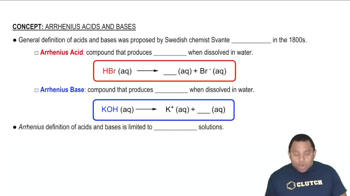
Arrhenius Definition of Acids and Bases

The Arrhenius definition states that acids are substances that increase the concentration of hydrogen ions (H⁺) in aqueous solution, while bases increase the concentration of hydroxide ions (OH⁻). This definition is foundational in understanding acid-base chemistry and provides a straightforward way to classify substances based on their behavior in water.
Video consigliato:
Percorso guidato
02:00
Arrhenius Acids and Bases

Chemical Equations

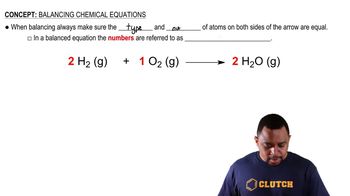
A chemical equation represents a chemical reaction using symbols and formulas to show the reactants and products involved. In the context of acids and bases, these equations illustrate how an acid donates protons (H⁺) or how a base produces hydroxide ions (OH⁻) in solution, which is essential for demonstrating their properties according to the Arrhenius definition.
Video consigliato:
Percorso guidato
01:32
Balancing Chemical Equations

Ionization of Acids

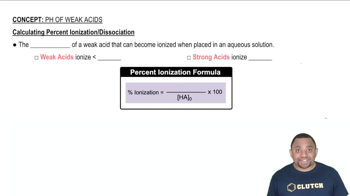
Ionization refers to the process by which an acid dissociates in water to produce H⁺ ions. For example, nitric acid (HNO3) ionizes in aqueous solution to release H⁺ and nitrate ions (NO3⁻). Understanding this process is crucial for identifying substances as acids and writing the corresponding chemical equations that reflect their behavior in solution.
Video consigliato:
Percorso guidato
01:15
Calculating Percent Ionization of Weak Acids