In each reaction, identify the Brønsted–Lowry acid, the Brønsted–Lowry base, the conjugate acid, and the conjugate base. c. CO32–(aq) + H2O(l) ⇌ HCO3–(aq) + OH–(aq)
Ch.17 - Acids and Bases
Tro5th EditionChemistry: A Molecular ApproachISBN: 9780134874371Non è quello che usi tu?Cambia libro di testo
Capitolo 17, Problema 36b
In each reaction, identify the Brønsted–Lowry acid, the Brønsted–Lowry base, the conjugate acid, and the conjugate base. b. CH3NH2(aq) + H2O(l) ⇌ CH3NH3+(aq) + OH–(aq)
Guida verificata passo dopo passo1
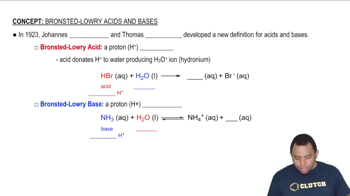
Identify the Brønsted–Lowry acid and base in the reactants: The Brønsted–Lowry acid is the species that donates a proton (H+), and the Brønsted–Lowry base is the species that accepts a proton.
In the reaction CH3NH2(aq) + H2O(l) -> CH3NH3+(aq) + OH-(aq), identify which species donates a proton and which accepts it.
CH3NH2 is the Brønsted–Lowry base because it accepts a proton from H2O, forming CH3NH3+.
H2O is the Brønsted–Lowry acid because it donates a proton to CH3NH2, forming OH-.
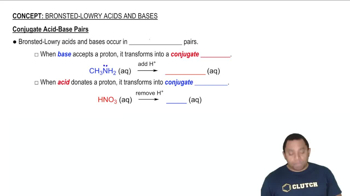
Identify the conjugate acid and conjugate base: The conjugate acid is the species formed when the base gains a proton, and the conjugate base is the species formed when the acid loses a proton. CH3NH3+ is the conjugate acid, and OH- is the conjugate base.

Risposta video verificata per un problema simile:
Questa soluzione video è stata consigliata dai nostri tutor come utile per risolvere questo problema.
Durata del video:
1mConcetti chiave
Ecco i concetti essenziali che devi comprendere per rispondere correttamente alla domanda.
Brønsted–Lowry Acid-Base Theory
The Brønsted–Lowry theory defines acids as proton donors and bases as proton acceptors. In this framework, an acid-base reaction involves the transfer of protons (H+) from the acid to the base. This theory expands the understanding of acid-base reactions beyond just the presence of hydroxide ions, allowing for a broader range of substances to be classified as acids or bases.
Video consigliato:
Percorso guidato
Bronsted-Lowry Acid-Base Theory
Conjugate Acid and Conjugate Base
In the context of Brønsted–Lowry theory, a conjugate acid is formed when a base accepts a proton, while a conjugate base is formed when an acid donates a proton. These pairs are related; for every acid, there is a corresponding conjugate base, and for every base, there is a corresponding conjugate acid. Understanding these relationships is crucial for analyzing acid-base reactions.
Video consigliato:
Percorso guidato
Conjugate Acid-Base Pairs
Identifying Species in Reactions
To analyze acid-base reactions, it is essential to identify the reactants and products involved. In the given reaction, CH3NH2 acts as a base by accepting a proton from water (H2O), which acts as an acid. The products, CH3NH3+ and OH-, represent the conjugate acid and conjugate base, respectively. Recognizing these roles is key to understanding the dynamics of the reaction.
Video consigliato:
Percorso guidato
Amphoteric Species
Pratica correlata
Domanda del libro di testo
1099
views
Domanda del libro di testo
In each reaction, identify the Brønsted–Lowry acid, the Brønsted–Lowry base, the conjugate acid, and the conjugate base. a. H2CO3(aq) + H2O(l) ⇌ H3O+(aq) + HCO3–(aq) c. HNO3(aq) + H2O(l) → H3O+(aq) + NO3–(aq)
339
views
1
rank
Domanda del libro di testo
In each reaction, identify the Brønsted–Lowry acid, the Brønsted–Lowry base, the conjugate acid, and the conjugate base. b. NH3(aq) + H2O(l) ⇌ NH4+(aq) + OH–(aq)
918
views
Domanda del libro di testo
Write the formula for the conjugate base of each acid. b. H2SO3
840
views
Domanda del libro di testo
Write the formula for the conjugate base of each acid. a. HCl
1394
views
Domanda del libro di testo
In each reaction, identify the Brønsted–Lowry acid, the Brønsted–Lowry base, the conjugate acid, and the conjugate base. d. C5H5N(aq) + H2O(l) ⇌ C5H5NH+(aq) + OH–(aq)
833
views
1
rank