Ch.18 - Aqueous Ionic Equilibrium
Tro - Chemistry: A Molecular Approach 5th Edition
Tro5th EditionChemistry: A Molecular ApproachISBN: 9780134874371Non è quello che usi tu?Cambia libro di testo
Capitolo 18, Problema 77

A 0.229-g sample of an unknown monoprotic acid is titrated with 0.112 M NaOH. The resulting titration curve is shown here. Determine the molar mass and pKa of the acid.
Titration curve showing pH change of a monoprotic acid with NaOH addition.

Guida verificata passo dopo passo
1
Identify the equivalence point on the titration curve, which is the point where the pH rapidly changes. This occurs around 25 mL of NaOH added.
Calculate the moles of NaOH added at the equivalence point using the formula: moles of NaOH = Molarity of NaOH * Volume of NaOH (in liters).
Since the acid is monoprotic, the moles of NaOH at the equivalence point are equal to the moles of the unknown acid.
Determine the molar mass of the unknown acid using the formula: Molar mass = mass of the acid sample / moles of the acid.
To find the pKa of the acid, locate the half-equivalence point on the titration curve, which is at half the volume of the equivalence point (around 12.5 mL). The pH at this volume is equal to the pKa of the acid.

Risposta video verificata per un problema simile:

Questa soluzione video è stata consigliata dai nostri tutor come utile per risolvere questo problema.

Concetti chiave

Ecco i concetti essenziali che devi comprendere per rispondere correttamente alla domanda.

Monoprotic Acid

A monoprotic acid is an acid that can donate only one proton (H⁺) per molecule during a chemical reaction. This characteristic simplifies the titration process, as the equivalence point occurs when the amount of base added is stoichiometrically equivalent to the amount of acid present. Understanding the behavior of monoprotic acids is crucial for determining their molar mass and pKa from titration data.
Video consigliato:

Titration Curve

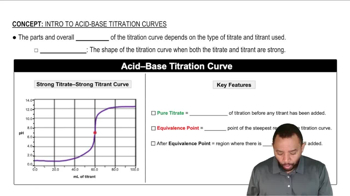
A titration curve is a graphical representation of the pH of a solution as a function of the volume of titrant added. For a monoprotic acid titrated with a strong base like NaOH, the curve typically shows a gradual increase in pH, followed by a steep rise at the equivalence point, and then levels off. Analyzing the shape of the curve helps identify the equivalence point and calculate the pKa of the acid.
Video consigliato:
Percorso guidato
02:16
Acid-Base Titration Curves

Molar Mass and pKa Calculation

The molar mass of the acid can be calculated using the mass of the acid sample and the volume of NaOH required to reach the equivalence point, applying stoichiometry. The pKa, which indicates the strength of the acid, can be determined from the pH at the half-equivalence point, where half of the acid has been neutralized. These calculations are essential for characterizing the unknown acid in the titration experiment.
Video consigliato:
Percorso guidato
03:12
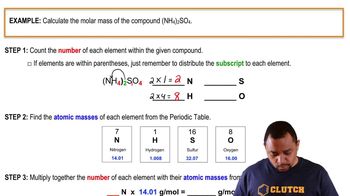
Molar Mass Calculation Example