Ch.18 - Aqueous Ionic Equilibrium
Tro - Chemistry: A Molecular Approach 5th Edition
Tro5th EditionChemistry: A Molecular ApproachISBN: 9780134874371Non è quello che usi tu?Cambia libro di testo
Capitolo 18, Problema 48c

A 100.0-mL buffer solution is 0.175 M in HClO and 0.150 M in NaClO. c. What is the pH after addition of 85.0 mg of NaOH?

Guida verificata passo dopo passo
1
Calculate the number of moles of NaOH added. Use the molar mass of NaOH (approximately 40 g/mol) to convert the mass of NaOH (85.0 mg) to moles.
Determine the change in the concentration of NaClO and HClO in the buffer solution. The NaOH will react with HClO, forming water and NaClO. Use the stoichiometry of the reaction: HClO + OH- → ClO- + H2O.
Recalculate the concentrations of HClO and NaClO in the buffer solution after the reaction. Subtract the moles of NaOH reacted from the initial moles of HClO and add the same amount to the moles of NaClO.
Use the Henderson-Hasselbalch equation to calculate the new pH of the buffer solution. The equation is pH = pKa + log([A-]/[HA]), where pKa is the acid dissociation constant of HClO, [A-] is the concentration of NaClO, and [HA] is the concentration of HClO.
Ensure that the buffer capacity is not exceeded by checking if the amount of NaOH added is significantly less than the amount of HClO present initially. If the buffer capacity is exceeded, the pH might change more drastically than predicted by the Henderson-Hasselbalch equation.

Risposta video verificata per un problema simile:

Questa soluzione video è stata consigliata dai nostri tutor come utile per risolvere questo problema.
Durata del video:
4m

Concetti chiave

Ecco i concetti essenziali che devi comprendere per rispondere correttamente alla domanda.

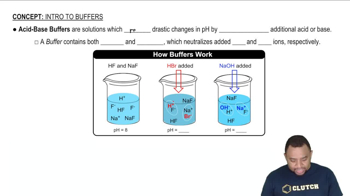
Buffer Solutions

Buffer solutions are mixtures that resist changes in pH when small amounts of acid or base are added. They typically consist of a weak acid and its conjugate base, or a weak base and its conjugate acid. In this case, the buffer is made from hypochlorous acid (HClO) and sodium hypochlorite (NaClO), which helps maintain a stable pH despite the addition of NaOH.
Video consigliato:
Percorso guidato
03:02
Buffer Solutions

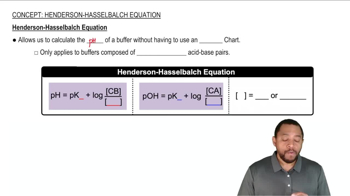
Henderson-Hasselbalch Equation

The Henderson-Hasselbalch equation is a mathematical formula used to calculate the pH of a buffer solution. It is expressed as pH = pKa + log([A-]/[HA]), where [A-] is the concentration of the conjugate base and [HA] is the concentration of the weak acid. This equation is essential for determining the pH after the addition of NaOH, as it allows for the adjustment of concentrations based on the reaction with the added base.
Video consigliato:
Percorso guidato
02:40
Henderson-Hasselbalch Equation

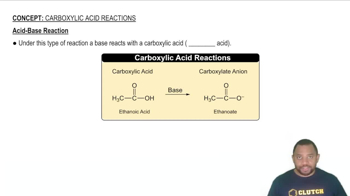
Stoichiometry of Acid-Base Reactions

Stoichiometry in acid-base reactions involves calculating the amounts of reactants and products involved in the reaction. When NaOH is added to the buffer, it reacts with HClO, converting some of the weak acid into its conjugate base, NaClO. Understanding the stoichiometric relationships helps in determining the new concentrations of HClO and NaClO, which are necessary for calculating the final pH.
Video consigliato:
Percorso guidato
01:09
Acid-Base Reaction