Ch.18 - Aqueous Ionic Equilibrium
Tro - Chemistry: A Molecular Approach 5th Edition
Tro5th EditionChemistry: A Molecular ApproachISBN: 9780134874371Non è quello che usi tu?Cambia libro di testo
Capitolo 18, Problema 74b

A 25.0-mL sample of 0.125 M pyridine is titrated with 0.100 M HCl. Calculate the pH at each volume of added acid: 10 mL.

Guida verificata passo dopo passo
1
Identify the initial moles of pyridine (C5H5N) in the solution using the formula: \( \text{moles} = \text{concentration} \times \text{volume} \).
Calculate the moles of HCl added using the formula: \( \text{moles} = \text{concentration} \times \text{volume} \).
Determine the reaction between pyridine (a weak base) and HCl (a strong acid), which forms pyridinium ion (C5H5NH^+). The reaction is: \( \text{C5H5N} + \text{HCl} \rightarrow \text{C5H5NH}^+ + \text{Cl}^- \).
Calculate the moles of pyridine and pyridinium ion after the reaction to find the remaining moles of pyridine and the moles of pyridinium ion formed.
Use the Henderson-Hasselbalch equation to calculate the pH: \( \text{pH} = \text{pK}_a + \log \left( \frac{[\text{base}]}{[\text{acid}]} \right) \), where \( \text{pK}_a \) is derived from the \( \text{K}_b \) of pyridine.

Risposta video verificata per un problema simile:

Questa soluzione video è stata consigliata dai nostri tutor come utile per risolvere questo problema.
Durata del video:
5m

Concetti chiave

Ecco i concetti essenziali che devi comprendere per rispondere correttamente alla domanda.

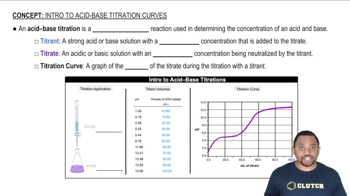
Acid-Base Titration

An acid-base titration is a quantitative analytical method used to determine the concentration of an acid or base in a solution. In this process, a solution of known concentration (the titrant) is added to a solution of unknown concentration until the reaction reaches its equivalence point, where the amount of acid equals the amount of base. The pH changes during the titration, and understanding this change is crucial for calculating the pH at specific volumes of titrant added.
Video consigliato:
Percorso guidato
03:04
Acid-Base Titration

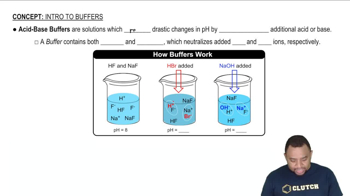
Buffer Solutions

Buffer solutions are mixtures that can resist changes in pH upon the addition of small amounts of acid or base. In this case, pyridine acts as a weak base and can form a buffer with its conjugate acid, pyridinium ion, when titrated with HCl. The presence of a buffer system is essential for understanding the pH changes during the titration, especially before reaching the equivalence point, where the solution can maintain a relatively stable pH.
Video consigliato:
Percorso guidato
03:02
Buffer Solutions

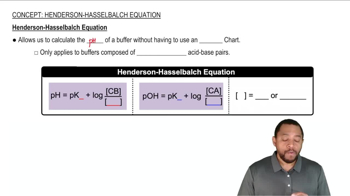
Henderson-Hasselbalch Equation

The Henderson-Hasselbalch equation is a mathematical formula used to calculate the pH of a buffer solution. It relates the pH of the solution to the pKa of the weak acid and the ratio of the concentrations of the conjugate base and the weak acid. This equation is particularly useful in titration problems involving weak acids and bases, as it allows for the determination of pH at various points in the titration process, including before and after the addition of titrant.
Video consigliato:
Percorso guidato
02:40
Henderson-Hasselbalch Equation