A 25.0-mL volume of a sodium hydroxide solution requires 19.6 mL of a 0.189 M hydrochloric acid for neutralization. A 10.0-mL volume of a phosphoric acid solution requires 34.9 mL of the sodium hydroxide solution for complete neutralization. Calculate the concentration of the phosphoric acid solution.
Ch.18 - Aqueous Ionic Equilibrium
Tro5th EditionChemistry: A Molecular ApproachISBN: 9780134874371Non è quello che usi tu?Cambia libro di testo
Capitolo 18, Problema 129
Calculate the solubility of CuX in a solution that is 0.150 M in NaCN. Ksp for CuX is 1.27⨉10-36.
Guida verificata passo dopo passo1
Identify the relevant chemical equilibrium: CuX(s) ⇌ Cu⁺(aq) + X⁻(aq).
Write the expression for the solubility product constant (Ksp): Ksp = [Cu⁺][X⁻].
Recognize that NaCN provides CN⁻ ions, which can complex with Cu⁺ to form Cu(CN)₂⁻, affecting the solubility of CuX.
Write the equilibrium expression for the complexation reaction: Cu⁺ + 2CN⁻ ⇌ Cu(CN)₂⁻, and note that this will reduce the concentration of free Cu⁺ ions.
Use the Ksp expression and the complexation equilibrium to set up equations that relate the solubility of CuX to the concentration of CN⁻, and solve for the solubility of CuX.

Risposta video verificata per un problema simile:
Questa soluzione video è stata consigliata dai nostri tutor come utile per risolvere questo problema.
Durata del video:
8mConcetti chiave
Ecco i concetti essenziali che devi comprendere per rispondere correttamente alla domanda.
Solubility Product Constant (Ksp)
The solubility product constant (Ksp) is an equilibrium constant that applies to the solubility of sparingly soluble ionic compounds. It is defined as the product of the molar concentrations of the ions, each raised to the power of their coefficients in the balanced equation. For a compound like CuX, Ksp helps determine how much of the compound can dissolve in a solution before reaching saturation.
Video consigliato:
Percorso guidato
Solubility Product Constant
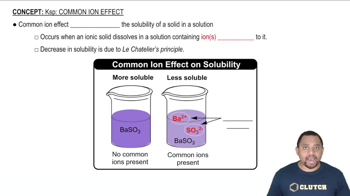
Common Ion Effect
The common ion effect refers to the decrease in solubility of an ionic compound when a common ion is added to the solution. In this case, the presence of NaCN introduces CN⁻ ions, which shifts the equilibrium of the dissolution of CuX, reducing its solubility. Understanding this effect is crucial for calculating the new solubility in the presence of a common ion.
Video consigliato:
Percorso guidato
Common Ion Effect
ICE Table (Initial, Change, Equilibrium)
An ICE table is a tool used to track the concentrations of reactants and products during a chemical reaction at different stages: Initial, Change, and Equilibrium. For solubility calculations, it helps organize the initial concentrations of ions, the changes that occur as the system reaches equilibrium, and the final concentrations. This systematic approach is essential for accurately determining the solubility of CuX in the given solution.
Video consigliato:
Percorso guidato
ICE Charts and Equilibrium Amount
Pratica correlata
Domanda del libro di testo
1304
views
Domanda del libro di testo
A 0.867-g sample of an unknown acid requires 32.2 mL of a 0.182 M barium hydroxide solution for neutralization. Assuming the acid is diprotic, calculate the molar mass of the acid.
1269
views
Domanda del libro di testo
Calculate the solubility of silver chloride in a solution that is 0.100 M in NH3.
966
views
Domanda del libro di testo
Pseudogout, a condition with symptoms similar to those of gout (see Problem 126), is caused by the formation of calcium diphosphate (Ca2P2O7) crystals within tendons, cartilage, and ligaments. Calcium diphosphate will precipitate out of blood plasma when diphosphate levels become abnormally high. If the calcium concentration in blood plasma is 9.2 mg/dL, and Ksp for calcium diphosphate is 8.64⨉10-13, what minimum concentration of diphosphate results in precipitation?
433
views
1
comments
