
A 5.55-g sample of a weak acid with Ka = 1.3⨉10-4 was combined with 5.00 mL of 6.00 M NaOH, and the resulting solution was diluted to 750.0 mL. The measured pH of the solution was 4.25. What is the molar mass of the weak acid?
Ch.18 - Aqueous Ionic Equilibrium
Tro5th EditionChemistry: A Molecular ApproachISBN: 9780134874371Non è quello che usi tu?Cambia libro di testo
Capitolo 18, Problema 125
If a hard water solution is saturated with calcium carbonate, what volume of the solution has to evaporate to deposit 1.00 × 10^2 mg of CaCO3, given that one of the main components of hard water is CaCO3, and when hard water evaporates, some of the CaCO3 is left behind as a white mineral deposit?
Guida verificata passo dopo passo1
Identify the molar mass of calcium carbonate (CaCO_3) by adding the atomic masses of calcium (Ca), carbon (C), and oxygen (O).
Convert the mass of CaCO_3 (1.00 \(\times\) 10^2 \(\text{ mg}\)) to grams by dividing by 1000.
Calculate the number of moles of CaCO_3 using the formula: \(\text{moles}\) = \(\frac{\text{mass in grams}\)}{\(\text{molar mass}\)}.
Determine the concentration of CaCO_3 in the saturated solution, which is typically given or can be found in a reference table.
Use the concentration to find the volume of solution needed to contain the calculated moles of CaCO_3, using the formula: \(\text{volume}\) = \(\frac{\text{moles}\)}{\(\text{concentration}\)}.
Concetti chiave
Ecco i concetti essenziali che devi comprendere per rispondere correttamente alla domanda.
Saturation and Solubility
Saturation refers to the point at which a solution can no longer dissolve additional solute at a given temperature and pressure. The solubility of a substance, like calcium carbonate (CaCO3), indicates how much of it can dissolve in a specific volume of solvent. Understanding these concepts is crucial for determining how much of the solution must evaporate to reach a point where CaCO3 precipitates out.
Video consigliato:
Percorso guidato
Solubility Rules
Evaporation and Concentration
Evaporation is the process by which liquid turns into vapor, leading to a decrease in the volume of the solution. As water evaporates, the concentration of dissolved substances, such as CaCO3, increases. This concept is essential for calculating how much of the solution must evaporate to achieve the desired concentration that allows for the deposition of a specific mass of CaCO3.
Video consigliato:
Percorso guidato
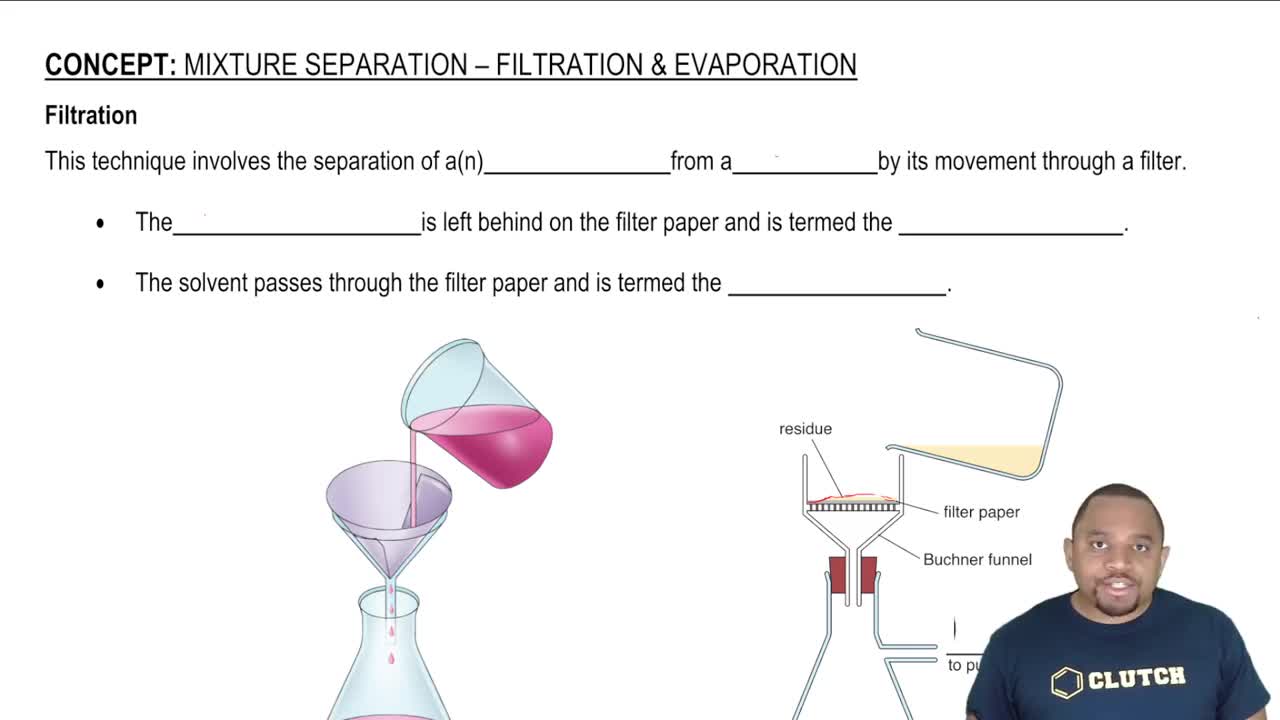
Filtration and Evaporation
Mass-Volume Relationships
Mass-volume relationships involve understanding how the mass of a solute relates to the volume of the solution in which it is dissolved. In this context, knowing the mass of CaCO3 to be deposited allows for the calculation of the volume of solution that must evaporate, based on the concentration of CaCO3 in the saturated solution. This relationship is fundamental for solving the problem presented.
Video consigliato:
Percorso guidato
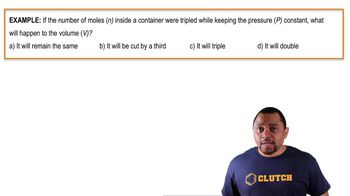
Relationship of Volume and Moles Example
Pratica correlata
Domanda del libro di testo
997
views
2
comments
Domanda del libro di testo
Calculate the solubility of silver chloride in a solution that is 0.100 M in NH3.
966
views
Domanda del libro di testo
Pseudogout, a condition with symptoms similar to those of gout (see Problem 126), is caused by the formation of calcium diphosphate (Ca2P2O7) crystals within tendons, cartilage, and ligaments. Calcium diphosphate will precipitate out of blood plasma when diphosphate levels become abnormally high. If the calcium concentration in blood plasma is 9.2 mg/dL, and Ksp for calcium diphosphate is 8.64⨉10-13, what minimum concentration of diphosphate results in precipitation?
433
views
1
comments
