Silver is composed of two naturally occurring isotopes: Ag-107 (51.839%) and Ag-109. The ratio of the masses of the two isotopes is 1.0187. What is the mass of Ag-107?
Ch.2 - Atoms & Elements
Tro5th EditionChemistry: A Molecular ApproachISBN: 9780134874371Non è quello che usi tu?Cambia libro di testo
Capitolo 2, Problema 143
A volatile liquid (one that easily evaporates) is put into a jar and the jar is then sealed. Does the mass of the sealed jar and its contents change upon the vaporization of the liquid?
Guida verificata passo dopo passo1
Identify the principle of conservation of mass, which states that mass is neither created nor destroyed in a closed system.
Recognize that the jar is sealed, making it a closed system where no mass can enter or leave.
Understand that when the liquid evaporates, it changes from a liquid to a gas, but the total mass of the liquid and gas remains the same.
Acknowledge that the mass of the jar and its contents is the sum of the mass of the jar, the liquid, and the vapor.
Conclude that since no mass is lost or gained in the sealed jar, the mass of the sealed jar and its contents does not change upon vaporization.

Risposta video verificata per un problema simile:
Questa soluzione video è stata consigliata dai nostri tutor come utile per risolvere questo problema.
Durata del video:
3mConcetti chiave
Ecco i concetti essenziali che devi comprendere per rispondere correttamente alla domanda.
Volatility and Vaporization
Volatility refers to the tendency of a substance to vaporize, which is influenced by its intermolecular forces. A volatile liquid easily transitions from a liquid to a gas at room temperature. When a volatile liquid is placed in a sealed jar, it will evaporate until it reaches equilibrium, where the rate of evaporation equals the rate of condensation.
Video consigliato:
Percorso guidato
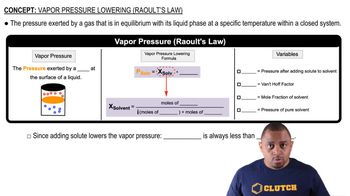
Raoult's Law and Vapor Pressure
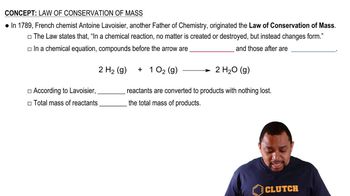
Conservation of Mass
The law of conservation of mass states that mass cannot be created or destroyed in a closed system. In the context of the sealed jar, even though the liquid evaporates, the total mass of the jar and its contents remains constant. The mass of the vapor produced is equal to the mass of the liquid that has evaporated, ensuring that the overall mass does not change.
Video consigliato:
Percorso guidato
Law of Conservation of Mass
Equilibrium in Closed Systems
In a closed system, such as a sealed jar, dynamic equilibrium can be established between the liquid and its vapor. At this point, the rate of evaporation of the liquid equals the rate of condensation of the vapor back into the liquid. This equilibrium does not affect the total mass of the system, as all molecules remain contained within the jar.
Video consigliato:
Percorso guidato
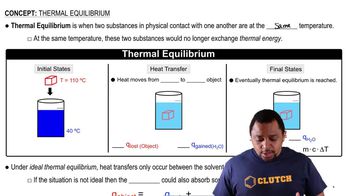
Thermal Equilibrium
Pratica correlata
Domanda del libro di testo
3328
views
Domanda del libro di testo
The U.S. Environmental Protection Agency (EPA) sets limits on healthful levels of air pollutants. The maximum level that the EPA considers safe for lead air pollution is 1.5 µg/m3. If your lungs were filled with air containing this level of lead, how many lead atoms would be in your lungs? (Assume a total lung volume of 5.50 L.)
1471
views
Domanda del libro di testo
Let a triangle represent atoms of element A and a circle represent atoms of element B. b. Draw an atomic view of the compound AB in a liquid state (molecules close together).
148
views
Domanda del libro di testo
Pure gold is usually too soft for jewelry, so it is often alloyed with other metals. How many gold atoms are in an 0.255-ounce, 18 K gold bracelet? (18 K gold is 75% gold by mass.)
1560
views