Ch.2 - Atoms & Elements
Tro - Chemistry: A Molecular Approach 5th Edition
Tro5th EditionChemistry: A Molecular ApproachISBN: 9780134874371Non è quello che usi tu?Cambia libro di testo
Capitolo 2, Problema 53a

Determine the number of protons and the number of neutrons in each isotope. a. 147N

Guida verificata passo dopo passo
1
Step 1: Identify the atomic number and mass number. In the isotope notation, the lower number is the atomic number (Z) and the upper number is the mass number (A). In this case, for the isotope 14 7N, 7 is the atomic number and 14 is the mass number.
Step 2: Determine the number of protons. The atomic number (Z) is equal to the number of protons in an atom. Therefore, the number of protons in this isotope is 7.
Step 3: Determine the number of neutrons. The number of neutrons in an atom can be found by subtracting the atomic number (Z) from the mass number (A). Therefore, the number of neutrons in this isotope is 14 - 7.
Step 4: Check your results. The sum of the number of protons and the number of neutrons should equal the mass number. In this case, 7 (protons) + 7 (neutrons) = 14, which is the mass number of the isotope.

Risposta video verificata per un problema simile:

Questa soluzione video è stata consigliata dai nostri tutor come utile per risolvere questo problema.
Durata del video:
2m

Concetti chiave

Ecco i concetti essenziali che devi comprendere per rispondere correttamente alla domanda.

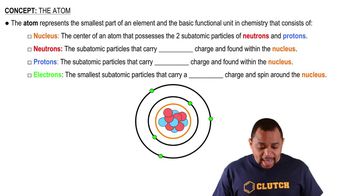
Isotopes

Isotopes are variants of a particular chemical element that have the same number of protons but different numbers of neutrons. This means they share the same atomic number but have different mass numbers. For example, nitrogen has several isotopes, including nitrogen-14, which has 7 protons and 7 neutrons.
Video consigliato:

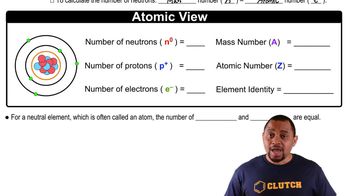
Atomic Number

The atomic number of an element is the number of protons found in the nucleus of its atoms. It uniquely identifies an element and determines its position in the periodic table. In the case of nitrogen (N), the atomic number is 7, indicating that all nitrogen atoms have 7 protons.
Video consigliato:

Mass Number

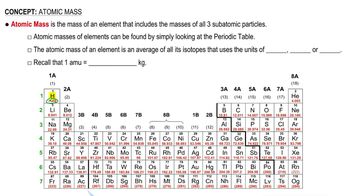
The mass number of an isotope is the total number of protons and neutrons in its nucleus. It is represented as the sum of these particles and is used to distinguish between different isotopes of the same element. For nitrogen-14, the mass number is 14, which is the sum of its 7 protons and 7 neutrons.
Video consigliato: